
A Complete Guide to Deploying Edge AI Video Analytics Across Multiple Business Locations
Managing operations across multiple business locations is no easy task. Whether you’re overseeing manufacturing plants in different cities, a chain of retail stores, regional warehouses, or multiple construction sites, maintaining consistent visibility into day-to-day operations becomes increasingly difficult as your footprint grows.
Many organisations already have CCTV systems installed at each location, but traditional surveillance creates more data than insights. Security teams often have to review hours of recorded footage, operational managers depend on local reporting, and business leaders struggle to gain a unified view of what’s happening across their facilities.
Edge AI changes this approach. Instead of using cameras solely for recording incidents, businesses can analyse live video streams in real time, automate monitoring, and receive actionable alerts from every location. VisionBot’s VB-EDGE AI Devices make this possible by bringing artificial intelligence directly to the edge, where video is captured.
This guide explores how organisations can deploy Edge AI video analytics across multiple business locations, centralise monitoring, and scale operations without replacing their existing surveillance infrastructure.
Why Multi-Site Monitoring Is Challenging
As businesses expand, they often inherit different surveillance systems, camera brands, and operational practices across locations. One warehouse may use one type of CCTV system, while another factory operates with an entirely different setup. Retail outlets may have varying camera layouts depending on store size, and construction sites constantly evolve as projects progress.
This fragmented environment creates several operational challenges.
Limited Visibility Across Locations
Managers typically receive updates through local teams rather than live operational data. If an incident occurs at a remote facility, it may take hours, or even days, for the right people to be informed.
Without a centralised monitoring approach, decision-making becomes reactive instead of proactive.
Manual Monitoring Doesn’t Scale
Monitoring hundreds or thousands of camera feeds across multiple sites is practically impossible using human operators alone. Fatigue, inconsistent supervision, and delayed responses reduce the effectiveness of traditional surveillance.
As businesses grow, increasing the number of monitoring personnel is neither practical nor cost-effective.
Inconsistent Safety and Compliance
Different facilities often interpret operational procedures differently. One manufacturing plant may strictly enforce PPE usage, while another may struggle with compliance. Similarly, retail stores may follow different queue management practices, and warehouse teams may handle material movement differently.
Without standardised monitoring, maintaining operational consistency becomes difficult.
Delayed Incident Response
When alerts depend on manual observation, valuable time is lost before action is taken. Equipment failures, safety violations, unauthorised access, or process disruptions can escalate quickly if they are not detected in real time.
High Bandwidth Requirements
Traditional cloud-based analytics often require continuous video streaming from every location to a central server. As organisations add more sites and cameras, network costs and bandwidth requirements increase significantly.
This is one of the primary reasons businesses are increasingly adopting edge-based AI processing.
Why Edge AI Is Better for Distributed Operations
Edge AI processes video directly where it is generated, at the business location itself, rather than sending every video stream to a remote cloud server.
With VisionBot’s VB-EDGE AI Devices, artificial intelligence runs locally, allowing each site to analyse its own camera feeds while transmitting only relevant events, alerts, and analytics to central dashboards.
This architecture provides several important advantages:
- Faster event detection
- Lower network bandwidth usage
- Reduced latency
- Better operational resilience
- Improved data privacy
- Easier scalability
Instead of turning every location into a bandwidth-heavy surveillance hub, each site becomes an intelligent edge node capable of making real-time decisions.
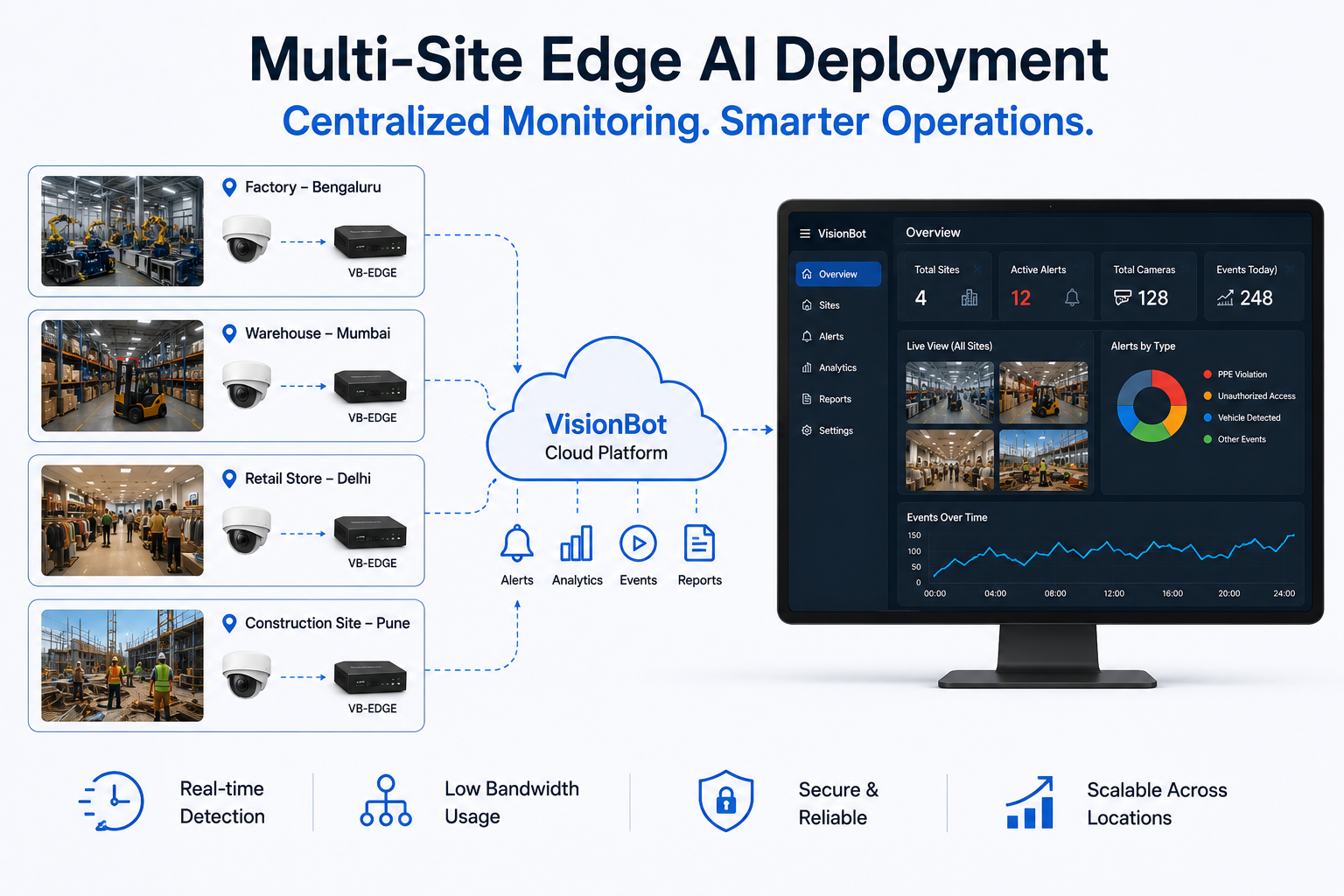
Understanding the VB-EDGE Deployment Architecture
One of the strengths of VisionBot platform is its flexible deployment architecture. Rather than forcing organisations to redesign their surveillance infrastructure, VB-EDGE integrates with existing IP cameras and CCTV networks.
A typical deployment consists of four layers.
Layer 1: Existing Camera Infrastructure
Most businesses already have surveillance cameras installed across facilities. These may include:
- IP cameras
- CCTV systems
- Network Video Recorders (NVRs)
- ONVIF-compatible cameras
VB-EDGE works with existing infrastructure, protecting previous investments while extending camera capabilities with AI-powered analytics.
Layer 2: VB-EDGE AI Devices
At each business location, a VB-EDGE device serves as the local intelligence engine.
The device receives video streams from connected cameras and processes them using AI models deployed specifically for that site’s operational requirements.
For example:
A warehouse may use:
- Forklift monitoring
- Material movement tracking
- Restricted area detection
A manufacturing plant may enable:
- PPE detection
- Process monitoring
- Equipment utilisation analysis
A retail store may focus on:
- Footfall analysis
- Queue monitoring
- Shelf availability
Construction projects may deploy:
- Worker safety monitoring
- Hazard zone detection
- Equipment tracking
Because processing happens locally, decisions are made almost instantly.
Layer 3: Central Analytics Platform
Although AI processing occurs locally, every site contributes operational insights to a central management platform.
Instead of receiving continuous video streams, headquarters receives:
- Alerts
- Analytics
- Events
- Reports
- Operational dashboards
This significantly reduces bandwidth while providing organisation-wide visibility.
Layer 4: Enterprise Dashboards
Executives, security teams, operations managers, and plant supervisors all access information through role-based dashboards.
This allows different teams to focus on metrics relevant to their responsibilities while maintaining a unified operational picture across all facilities.
Centralised Dashboards for Complete Operational Visibility
One of the biggest advantages of deploying VB-EDGE across multiple locations is the ability to centralise operational intelligence.
Instead of logging into separate surveillance systems for each facility, decision-makers can monitor all locations from a single interface.
The dashboard provides visibility into:
- Active alerts
- Safety compliance
- Operational KPIs
- Camera health
- AI event history
- Site-wise analytics
- Trend analysis
- Historical reports
For organisations with facilities spread across multiple regions, this eliminates information silos and supports faster decision-making.
For example, a manufacturing company with factories in Bengaluru, Pune, and Chennai can compare PPE compliance across all plants. A retail chain can monitor customer footfall across every store, while a logistics company can review warehouse activity from multiple distribution centres in one place.
Node and Camera Integration Across Multiple Locations
Deploying Edge AI across different sites does not have to be disruptive. VisionBot’s architecture is designed to simplify onboarding, even when facilities vary in size, layout, or camera infrastructure.
Step 1: Site Assessment
Each location is evaluated to understand:
- Existing camera infrastructure
- Network availability
- AI use cases
- Coverage gaps
- Operational workflows
A warehouse may prioritise logistics monitoring, while a factory may require production analytics. This assessment ensures that the AI deployment aligns with each site’s operational goals.
Step 2: Installing VB-EDGE Nodes
Once the assessment is complete, a VB-EDGE device is installed at each location. These devices act as local AI processing nodes, handling video analytics on-site.
Depending on the number of cameras and processing requirements, organisations can deploy multiple edge nodes within larger facilities.
Step 3: Camera Integration
VB-EDGE connects with existing IP cameras and surveillance networks. Cameras are mapped to specific AI models based on their location and purpose.
For example:
Warehouse A
- Loading dock cameras → Material movement tracking
- Yard cameras → Vehicle monitoring
- Storage aisles → Forklift analytics
Factory B
- Production line → Process monitoring
- Entry gates → PPE detection
- Packaging section → Workflow analytics
Retail Store
- Entrance → Footfall analysis
- Checkout → Queue monitoring
- Sales floor → Customer movement insights
This targeted approach ensures that each camera delivers meaningful operational data rather than generic surveillance footage.
Step 4: AI Model Deployment
Once cameras are connected, the required AI models are deployed to the edge devices.
Unlike traditional systems that rely on a one-size-fits-all approach, each site can run different AI models based on its operational needs. New models can also be added as business requirements evolve, allowing organisations to expand capabilities without replacing hardware.
Step 5: Dashboard Configuration
After deployment, all sites are linked to central dashboards.
Managers can organise facilities by:
- Region
- Business unit
- Operational category
- Plant
- Warehouse
- Retail outlet
This structure makes monitoring hundreds of locations both practical and efficient.
Intelligent Alert Management Across Sites
As the number of monitored locations grows, so does the number of events generated. Without a structured alerting system, teams risk becoming overwhelmed by notifications.
VB-EDGE supports configurable alert management so that only relevant events reach the right people.
For example:
- A PPE violation in a factory can be sent to the plant supervisor.
- A forklift entering a restricted warehouse zone can notify the warehouse manager.
- A long checkout queue can alert the retail store manager.
- A worker entering a hazardous construction area can trigger an immediate notification for the site safety officer.
Alerts can also be prioritised based on severity, enabling teams to focus first on incidents that require urgent attention. This targeted approach reduces alert fatigue while improving response times.
Scaling AI Across Growing Businesses
A major advantage of the VB-EDGE architecture is its ability to scale alongside business growth.
Many organisations begin with a pilot deployment at one location before expanding to additional sites. Because each VB-EDGE device operates independently while remaining connected to the central platform, scaling is straightforward.
As businesses open new factories, warehouses, retail stores, or project sites, they can simply install additional edge nodes, integrate existing cameras, deploy the required AI models, and connect the new location to the central dashboard.
There is no need to redesign the entire surveillance network or migrate all processing to a larger cloud infrastructure. Existing deployments continue to function while new sites are added incrementally.
This modular architecture is especially valuable for organisations with geographically distributed operations, where different locations may have varying camera counts, layouts, and operational priorities.
Why Businesses Choose VB-EDGE for Multi-Site Deployments
Deploying AI across multiple business locations requires more than intelligent algorithms, it requires a platform that is reliable, flexible, and easy to manage at scale.
VB-EDGE addresses these requirements by combining edge computing with enterprise-grade video analytics.
Key advantages include:
- AI processing at the edge for faster response times.
- Compatibility with existing IP cameras and CCTV systems.
- Lower bandwidth consumption by processing video locally.
- Centralised dashboards for unified operational visibility.
- Flexible deployment of different AI models at different sites.
- Real-time alerts tailored to specific roles and operational needs.
- Scalable architecture that supports business expansion without major infrastructure changes.
- Reduced manual monitoring while improving safety, compliance, and operational efficiency.
Whether an organisation manages three facilities or three hundred, the same architecture can support consistent AI-driven monitoring across all locations.
Building Smarter Multi-Site Operations with Edge AI
As businesses grow, maintaining visibility across multiple locations becomes increasingly complex. Traditional surveillance systems provide recordings, but they rarely deliver the real-time intelligence needed to improve safety, streamline operations, or respond quickly to incidents.
VisionBot’s VB-EDGE AI Devices bridge this gap by bringing intelligent video analytics directly to the edge. Each location becomes a self-sufficient AI-enabled node, capable of analysing live video, detecting operational events, and generating actionable insights without relying on continuous cloud processing.
When these edge deployments are connected through centralised dashboards, organisations gain a unified view of operations across warehouses, factories, construction sites, retail stores, and other facilities. From standardising safety compliance to monitoring workflows and responding to critical alerts, businesses can manage distributed operations with greater confidence and efficiency.
For organisations planning to scale their AI initiatives, the combination of local processing, centralised management, and flexible deployment makes VB-EDGE a practical foundation for modern, multi-site video analytics. Instead of treating surveillance as a passive recording system, businesses can transform it into an intelligent operational platform that grows alongside their ambitions.