
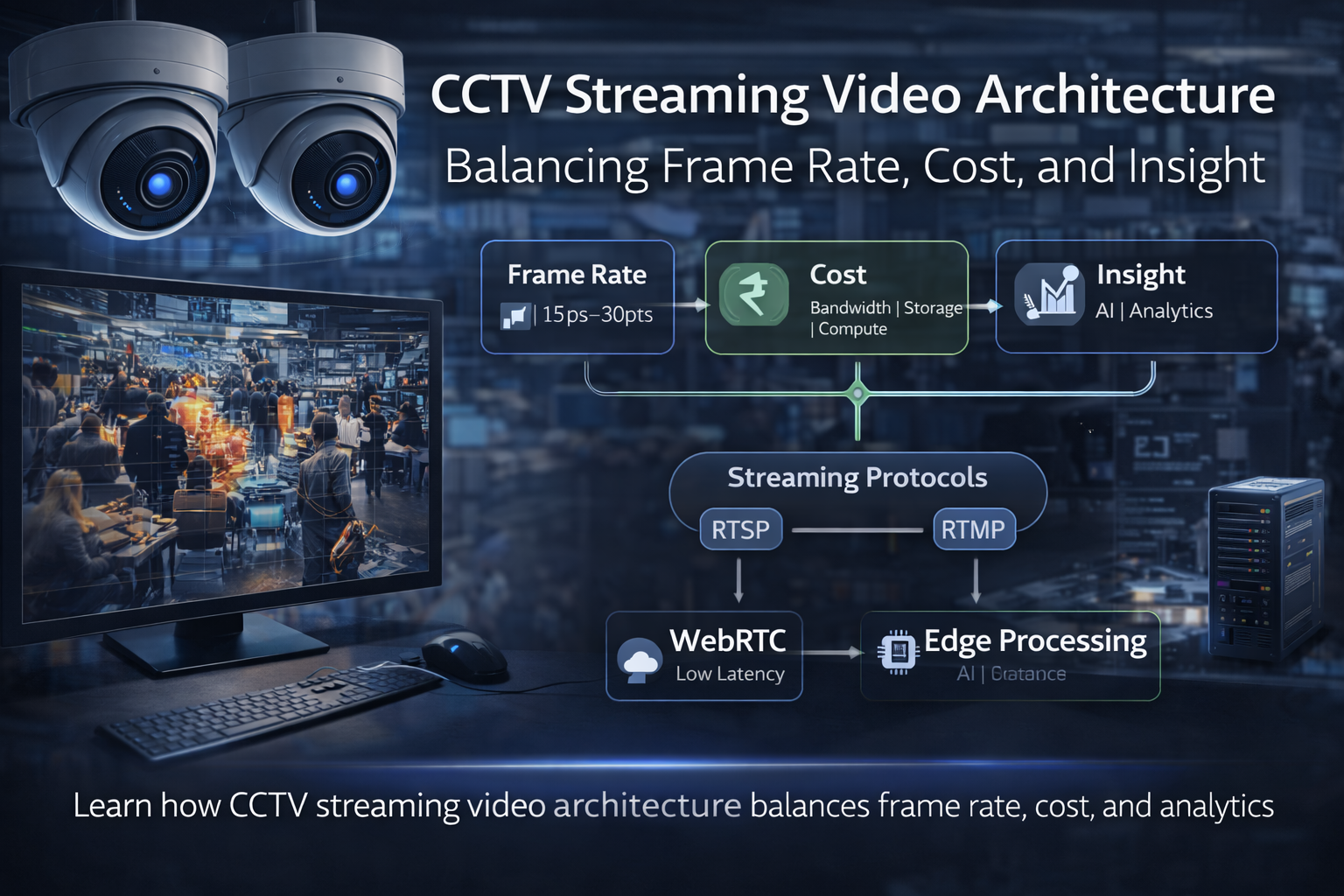
CCTV Streaming Video Architecture: Balancing Frame Rate, Cost, and Insight
In the modern security-conscious and data-oriented society, cctv streaming video has now been taken to a whole new level, far beyond passive recording. The latest CCTV systems are believed to provide real-time visibility, actionable intelligence, and scalable performance- usually on hundreds/thousands of cameras. To make this possible, well-planned streaming architectures are essential to balance frame rate, cost, and insight generation.
This blog will discuss the operation of CCTV streaming video architecture, trade-offs, and how more value can be unlocked with limited infrastructure budget constraints by the modern streaming video protocols and analytics pipeline.
Understanding CCTV Streaming Video Architecture
However, in essence, a CCTV streaming video architecture describes the movement of video between cameras and the systems that consume it. This consists of capture, encoding, transport, processing, storage and visualization layers.
Traditionally, conventional CCTV systems were aimed at capturing images to be viewed later. Today’s systems must support:
1. Live monitoring
2. Low-latency alerts
3. AI-based analytics
4. Remote and web-based access
As a result, every tier of the architecture presents design choices that affect performance and cost, particularly at scale.
Frame Rate: How Much Is Enough?
Frame rate constitutes the number of images per second that are sequenced off a camera. Although the greater frame rates enhance the clarity of motion, they also raise the bandwidth, computation and storage expenses considerably.
Key Frame Rate Considerations
1. 15–30 FPS: Real-time tracking and identification of faces.
2. 5–10 FPS: Usually adequate to general survey.
3. 1–3 FPS: Applicable to low-activity settings.
Streaming at 30 FPS is not always needed in many deployments. Smart cctv streaming video architectures dynamically adapt frame rates depending on:
1. Motion detection
2. Time of day
3. Scene complexity
The strategy is an adaptive one that retains detail where necessary whilst using minimal resources.
Cost Drivers in CCTV Streaming Systems
The cost of CCTV streaming grows exponentially as the number of cameras increases. Major contributors include:
1. Bandwidth
The more frame rates and resolutions one has, the more outbound traffic will be generated, particularly in remote or cloud-based monitoring.
2. Compute
Inference of real-time transcoding, analytics and AI requires a lot of CPU or GPU resources.
3. Storage
High-quality continuous recording is easily cost-prohibitive without intelligent retention policies.
The optimal cctv streaming video design eliminates redundant data flow without compromising situational awareness.
Streaming Protocols and Architectural Choices
RTSP vs RTMP Streaming in CCTV Systems
The proper selection of protocol is key to a CCTV streaming architecture. The controversy between RTSP vs RTMP streaming is particularly relevant in the field of surveillance.
RTSP (Real Time Streaming Protocol)
1. Widespread with IP cameras.
2. Efficient camera to server streaming.
3. Designed to fit into controlled networks.
RTMP (Real Time Messaging Protocol)
1. Live broadcasting was a historical favourite.
2. Requires more overhead
3. Not as appropriate as a modern browser.
In the majority of luggage systems employing CCTV, RTSP vs RTMP streaming decisions prefer RTSP ingestion and other protocols downstream to distribute.
Bridging Legacy Streams to Modern Platforms
RTSP to WebRTC Surveillance Architecture
Although RTSP is efficient between the camera and server, it cannot be used in a browser. Here we have RTSP to WebRTC surveillance architectures.
WebRTC enables:
1. Ultra-low latency viewing
2. Web and mobile browsing.
3. Peer-to-peer streaming security.
Organizations can also, without requiring plugins or heavy clients, provide live CCTV feeds on web dashboards by converting camera feeds with RTSP into WebRTC surveillance pipelines.
This practice is becoming important in relation to:
1. Smart cities
2. Retail analytics
3. Remote operations centers
Balancing Insight with Infrastructure Load
Analytics-Driven Streaming
Contemporary cctv streaming video applications are not merely about viewing anymore but about comprehending. AI and computer vision identify insights like:
1. Intrusion detection
2. Crowd density
•3. Object tracking
4. Behavior analysis
Nonetheless, it is costly to run analytics per frame. Smart architectures trade insight and cost by:
1. Sampling is smart.
2. First-level filtering on running edge analytics.
3. Only sending pertinent clips to central systems.
This staged processing model guarantees self-insight without wasteful compute burn.
Edge vs Cloud: Where Processing Happens
Edge-First Architectures
Video processing near the camera minimizes latency and bandwidth consumption. Edge devices can:
1. Filter noise
2. Detect events
3. Reduction in frame rates during still scenes.
Cloud-Enhanced Architectures
Cloud systems consolidate data across sites, which allows:
1. Cross-camera intelligence
2. Long-term analytics
3. Centralized management
Edge filtering with cloud intelligence provides an optimal balance of a hybrid cctv streaming video approach.
Storage Strategies That Reduce Cost
Constant recording is no longer the norm. Modern systems use:
1. Event-based recording
2. Variable bit-rate encoding
3. Tiered storage (hot, warm, cold)
With the help of alignment of storage policies and business requirements, CCTV supports do not squander resources to keep the important evidence intact.
Security and Compliance Considerations
Streaming video systems should also consider:
1. Encryption in transit
2. Role-based access
3. Requirements of data residency.
There are also protocols such as WebRTC that have integrated encryption, and RTSP to WebRTC surveillance is a powerful option against compliance-intensive settings.
Designing for Scalability and Future Growth
With increasing deployments, early architectural choices may either facilitate or constrain growth. Scalable cctv streaming video applications:
1. Use modular services
2. Flexibility of support protocols.
3. Easily integrated with AI pipelines.
No hard-coded assumptions of frame rates, resolutions or viewers. Flexibility is key.
Final Thoughts
CCTV systems are no longer passive devices, but are active intelligence platforms. The distinction between an expensive video system and an ROI involved system is architectural.
Organisations can realise the true value of video infrastructure by balancing frame rate, cost, and insight, and by exploring modern solutions such as RTSP vs RTMP streaming choices and RTSP to WebRTC surveillance pipelines.
Ready to Build Smarter Video Systems?
To find out how VisionBot enables companies to build scalable and smart CCTV streaming infrastructures with the help of real-time AI insights.
Get more information at https://visionbot.com/ and change the way you see, interpret, and operate on video data.