
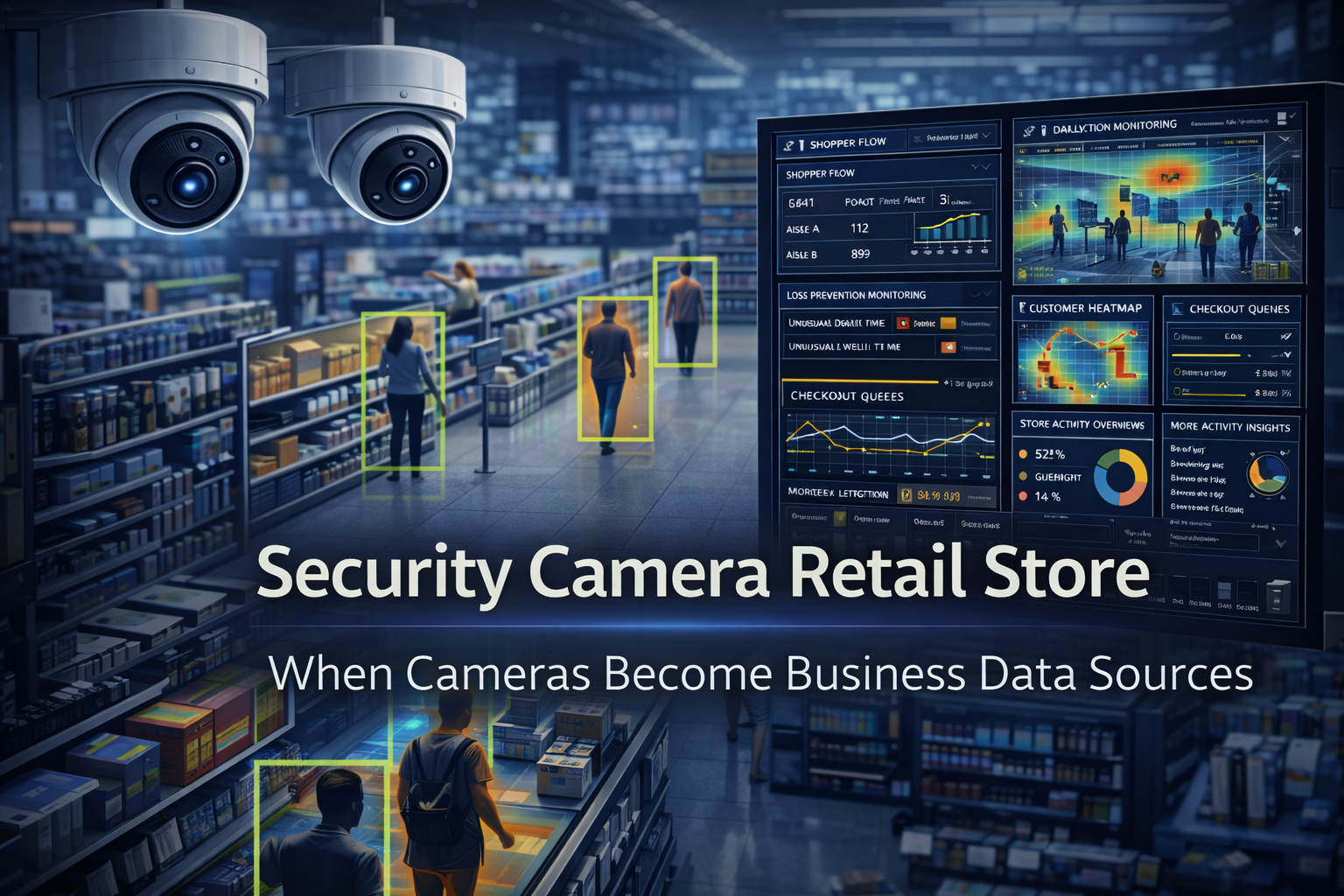
How a Security Camera Retail Store Changes When Cameras Become Data Sources
Since time immemorial, cameras at the checkout of retail shops have only served one and only purpose and that purpose is to record footage in case of misfortune. Robbery, fights, crashes–security agencies would play back the video afterwards and wish it had paid off.
But there is something basic changing.
As soon as a security camera retail store starts to think of its cameras not as passive recording apparatus but as usable sources of information, the overall business concept begins to change. Cameras cease to be a cost centre and begin to be a strategic asset, one that determines operations, customer experience, staffing, merchandising, and even revenue growth.
This change is not about adding more cameras. It is about getting intelligence out of the video that is already present.
Instead of examining physical differences, we should focus on how retail security cameras function as data engines rather than digital filing cabinets.
From Surveillance to Intelligence in the Modern Security Camera Retail Store
Conventional surveillance will only respond to one question: What happened?
The vision provided by the data answers a far stronger question: What is presently going on, and what shall we next do?
Modern security camera retail store analyze video feeds in real time to understand patterns rather than individual events. This encompasses customer movement, dwell time, queue length, shelf interaction and employee activity- without the need for human review of each frame.
The greatest change of mind is this:
the video turns into a flow of ordered signs, and not an ordered film.
Retailers receive dashboards, alerts, and metrics that they can act upon as opposed to thousands of hours of video.
What Changes When You Treat Cameras as Data Sources
1. Cameras Start Informing Business Decisions
After cameras produce structured insights, store managers can no longer rely only on intuition.
For example:
• Are clients always bypassing specific aisles?
What displays are appealing and fail to convert?
• When is there congestion or underutilization during the day?
A video data pipeline retail accomplishes this by curating raw footage into events, counts, and trends that teams can integrate into BI tools.
Option 2 (more concise):
This method will make evidence-based rather than anecdotal store design decisions.
2. Loss Prevention Becomes Predictive, Not Reactive
Security increases–but smarter.
A data-enabled security camera retail store can identify unusual behaviour patterns immediately without resorting to shrinkage reports:
- Continuous hanging around high-value items.
- Co-ordinated action among people.
- Staff-pathology behavior.
Using metadata from CCTV (motion vectors, dwell-duration and object interactions), retailers can intercede at an earlier stage, interact with fewer false alarms and direct their staffing where they are needed most.
Security teams cease to review footage and go on to prevent any incidents.
Operational Efficiency Gets a Measurable Boost
3. Staffing Matches Real Demand
Among the immediate operational benefits is matching the number of staff with actual customer presence.
Based on insights derived through the use of video, retailers will be able to:
- Staffing adjustments should be by hour, not schedule.
- Determine real-time understaffed areas.
- Minimise the wait at the checkout without excessive staffing.
Here, a strong video data pipeline retail strategy proves itself once again, converting footfall and flow data into workforce optimization indicators.
Managers, rather than posing the question, How busy do we think the store will be, pose the question, What does the data show right now?
4. Customer Experience Becomes Visible and Measurable
The customer experience has always been hard to measure within physical shops. Surveys and mystery shoppers can only glimpse the reality.
When cameras are sources of data, experience is visible:
- Long queues are automatically identified.
- Bottlenecks on busy displays are viewed.
- Abandoned areas are indicators of layout or signage problems.
Through the interpretation of metadata from CCTV, retailers are equipped with continuous feedback loops without disrupting the shoppers or making an educated guess.
This transforms CX from a soft metric into a hard operational KPI.
Data-Driven Merchandising in a Security Camera Retail Store
5. Product Placement Is Optimized Using Real Behavior
Data at the point of sale informs you of what was sold. Video data informs you about what was almost sold.
Within a data-driven security camera retail store, teams may analyse:
- What products are picked and returned.
- Duration hospitals spend on displays.
- Do promotions appeal or fall on deaf ears?
These lessons allow the retailers to test layouts more quickly, refine planograms, and enhance conversion without altering inventory.
Merchandising is no longer a quarterly redesign, but an experiment.
6. Multi-Store Comparisons Become Possible
When video analytics is made standardised by location, retailers can at last compare stores apples to apples.
For example:
- Why does Store A pay off better than Store B with the same products?
- What layouts result in longer dwell time?
- What is the distribution of customer flow by region?
Thinking of cameras as a source of data opens an exchangeable language of measures across sites, leveraging optimisation at scale.
Privacy, Ethics, and Trust Still Matter
7. Data-First Doesn’t Mean People-Last
A myth is that video analytics is surveillance run amok. In practice, the contemporary systems emphasize patterns rather than identities.
Anonymised insights are used at a responsible security camera retail store:
- No facial recognition
- No personal identification
- No personal tracking past session-based behaviour.
Retailers can innovate with customer trust and compliance with regulatory requirements through behaviour trends, instead of focusing on personal information.
The Technology Shift Behind the Scenes
None of this would be possible without AI, but architecture.
Successful retailers develop systems in which:
- Cameras enter scalable processing layers.
- Data are fed into dashboards and alerts.
- Video intelligence can combine with POS, inventory and workforce tools.
That is why the concept of video data pipeline retail is so essential. Without it, insights would be walled, weak, and unscalable.
Why This Shift Is Happening Now
Three forces are converging:
- Increasing costs require increased operational efficiency.
- Store experience has become a competitive advantage.
- Computer vision is now large enough to use in the real world.
Collectively, they are compelling retailers to get better out of the existing infrastructure- and cameras are everywhere already.
To any security camera retail store, the question is no longer whether the video is going to turn out to be data, but when.
The Future of Retail Is Watching Patterns, Not Footage
In cases where cameras are referred to as a source of data:
- Security becomes smarter
- Operations become leaner
- The experience is quantifiable.
- Decision-making will be quicker and more secure.
Retail does not require additional screens of live video.
It requires some intelligence going on in the background, informing all decisions made.
That is the actual change.
Interested in making your current cameras an actual time intelligence engine?
Pay a visit to VisionBot, which enables retailers to query video using actionable insights without the need to install additional equipment.