
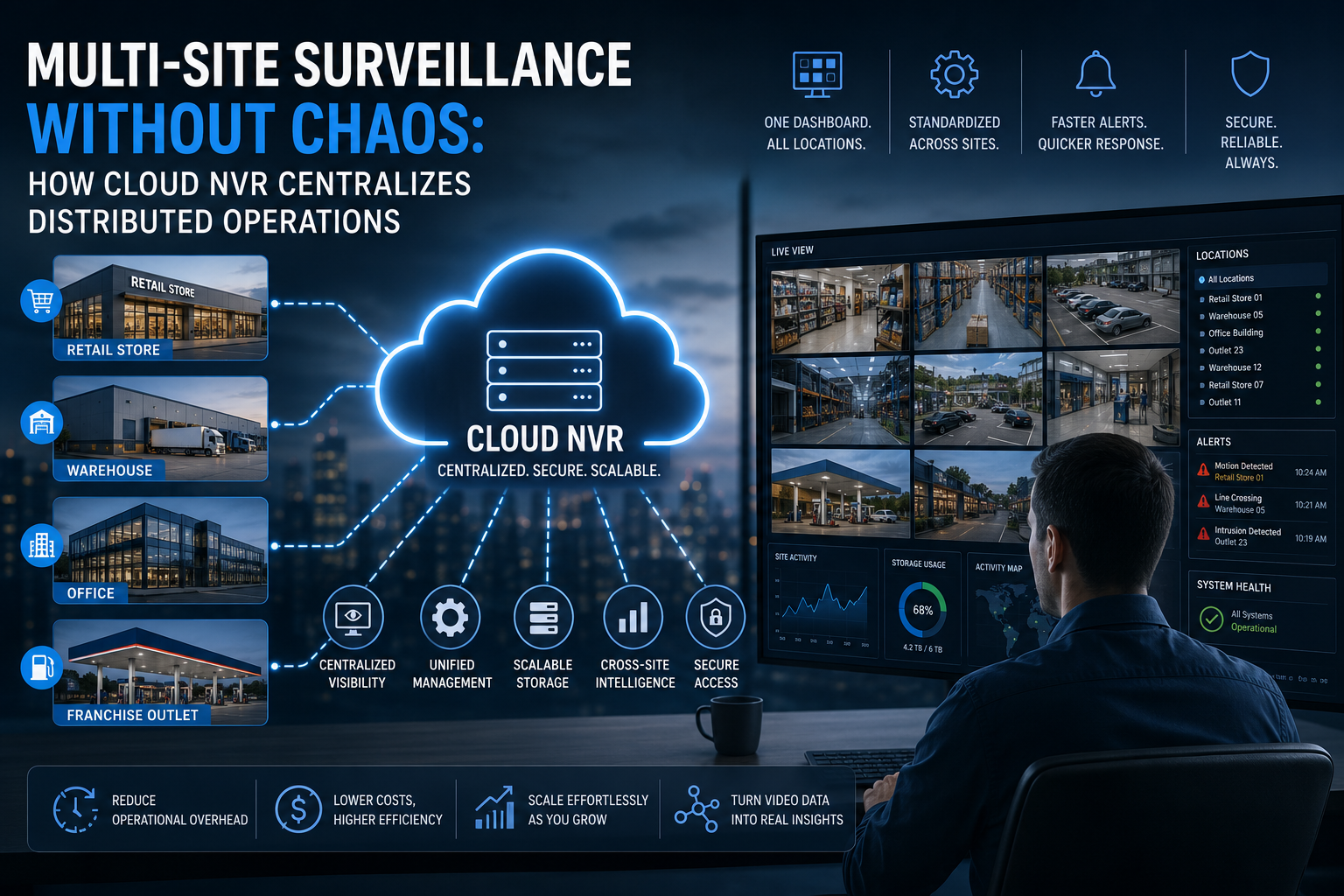
Multi-Site Surveillance Without Chaos: How Cloud NVR Centralizes Distributed Operations
Introduction: When Surveillance Scales, Complexity Explodes
Running surveillance at one location is manageable.
You have:
- A few cameras
- A local recorder
- A team that understands the setup
Now multiply that across:
- 10 retail stores
- 25 warehouses
- 100 franchise outlets
Suddenly, what was simple becomes chaotic.
You are dealing with:
- Different hardware setups
- Inconsistent configurations
- Disconnected data
- Limited visibility across sites
This is where most surveillance systems start to break, not because the technology is weak, but because the architecture was never designed for distribution.
Cloud NVR (Network Video Recorder) changes that equation.
The Core Problem: Fragmentation Across Locations
Traditional surveillance systems are built site-by-site.
Each location operates independently with:
- Local storage
- Local configurations
- Local monitoring
This creates fragmentation.
You cannot:
- View all sites in one place
- Apply consistent policies
- Track events across locations
Every site becomes its own silo.
And as the number of sites increases, so does the operational burden.
Why Traditional NVR Setups Don’t Scale
Local NVR systems work well in isolation.
But at scale, they introduce several problems:
Lack of Central Visibility
You need to log into each system separately.
Inconsistent Configurations
Different teams set up systems differently.
Manual Maintenance
Updates and troubleshooting must be done per site.
Limited Data Utilisation
Footage stays local and is rarely used for broader insights.
These limitations make it difficult to operate efficiently across multiple locations.
What Cloud NVR Actually Changes
Cloud NVR is not just about storing video remotely.
It is about centralising control while keeping operations distributed.
Instead of managing each site independently, you manage the entire network as a unified system.
This introduces:
- Central access
- Unified configuration
- Scalable storage
- Cross-site intelligence
Centralised Visibility: One Dashboard, All Locations
One of the biggest advantages is visibility.
With Cloud NVR, you can:
- Monitor multiple locations from a single interface
- Switch between sites instantly
- View live and recorded footage without logging into separate systems
This eliminates:
- Operational friction
- Time wasted navigating systems
It also improves:
- Response speed
- Situational awareness
Standardisation Across Sites
When systems are decentralised, inconsistencies creep in.
Different sites may have:
- Different camera settings
- Different retention policies
- Different alert configurations
Cloud NVR allows you to:
- Apply uniform settings across all locations
- Enforce consistent standards
- Reduce configuration errors
This creates a more predictable and manageable system.
Simplified Maintenance and Updates
Managing updates across multiple locations is a major challenge.
With local systems, updates require:
- On-site intervention
- Manual coordination
- Downtime planning
Cloud NVR centralises this process.
You can:
- Push updates remotely
- Monitor system health centrally
- Resolve issues without physical presence
This reduces:
- Operational overhead
- Downtime
- Maintenance costs
Scalable Storage Without Infrastructure Burden
Storage is one of the biggest constraints in surveillance systems.
Local storage:
- Has fixed capacity
- Requires hardware upgrades
- Needs manual management
Cloud storage offers:
- Elastic capacity
- Automatic scaling
- Centralised management
You no longer need to:
- Plan for storage expansion per site
- Worry about running out of space
Cross-Site Intelligence: The Real Advantage
The real power of Cloud NVR is not just centralisation.
It is the ability to connect data across locations.
This enables:
- Pattern recognition across sites
- Comparative analysis
- Centralised reporting
For example:
- Identifying recurring incidents across stores
- Tracking operational inefficiencies
- Understanding behavioral patterns at scale
This transforms surveillance from a passive system into an active intelligence layer.
Faster Incident Response
In distributed systems, response time is often delayed by:
- Lack of visibility
- Communication gaps
- Data access issues
Cloud NVR improves response by:
- Providing instant access to footage
- Enabling remote investigation
- Allowing central teams to act immediately
This is especially critical for:
- Security incidents
- Operational disruptions
- Compliance checks
Role-Based Access and Control
Managing who can access what becomes complex at scale.
Cloud NVR allows:
- Role-based permissions
- Controlled access to specific locations
- Centralised user management
This ensures:
- Security
- Accountability
- Operational clarity
Reliability Across Distributed Systems
One concern with centralisation is reliability.
Cloud NVR systems are designed to handle:
- Redundancy
- Backup storage
- Failover mechanisms
Even if one site faces issues:
- Data can still be accessed
- Operations can continue
This improves overall system resilience.
Cost Efficiency Through Centralisation
While cloud systems introduce ongoing costs, they also reduce:
- Hardware investment
- Maintenance expenses
- On-site support requirements
Instead of:
- Managing multiple independent systems
You manage:
- A unified platform
This leads to better resource utilisation.
Common Challenges Without Cloud NVR
Let’s be direct.
Without a centralised system, teams face:
- Delayed incident detection
- Inconsistent data across sites
- High operational overhead
- Limited scalability
These issues grow with every new location.
A Practical Use Case: Multi-Store Retail Chain
Consider a retail brand with 50 stores.
Without Cloud NVR:
- Each store manages its own system
- Head office has limited visibility
- Incident reviews are slow
With Cloud NVR:
- All stores are visible from one dashboard
- Central team monitors operations
- Insights are aggregated across locations
This leads to:
- Faster decisions
- Better control
- Improved efficiency
The Strategic Shift: From Monitoring to Management
Traditional systems focus on monitoring.
Cloud NVR enables:
- Active management of surveillance networks
This includes:
- Policy enforcement
- Performance tracking
- Continuous optimisation
The system evolves from being reactive to proactive.
The Future: Intelligent, Connected Surveillance
As systems evolve, Cloud NVR will integrate with:
- AI-based analytics
- Automated alerting
- Predictive insights
This will further enhance:
- Operational efficiency
- Decision-making capabilities
Final Takeaway
Managing surveillance across multiple locations is not just a technical challenge.
It is an operational one.
Without centralisation, complexity grows faster than the system itself.
Cloud NVR brings structure to that complexity by:
- Unifying control
- Standardising operations
- Enabling cross-site intelligence
It turns fragmented systems into a cohesive network.
Build Smarter, Not Harder with VisionBot
If you’re managing surveillance across multiple sites, the question is no longer whether you need better cameras or more storage.
The real question is:
Do you have control over your entire surveillance ecosystem?
VisionBot is designed to give you exactly that.
- Centralised monitoring across all locations
- Intelligent video analytics built for real-world operations
- Scalable infrastructure without operational chaos
Whether you’re running retail chains, warehouses, or distributed facilities, VisionBot helps you move from fragmented systems to unified intelligence.
Ready to take control of your surveillance operations?
Explore how VisionBot can simplify, scale, and strengthen your entire video ecosystem.