
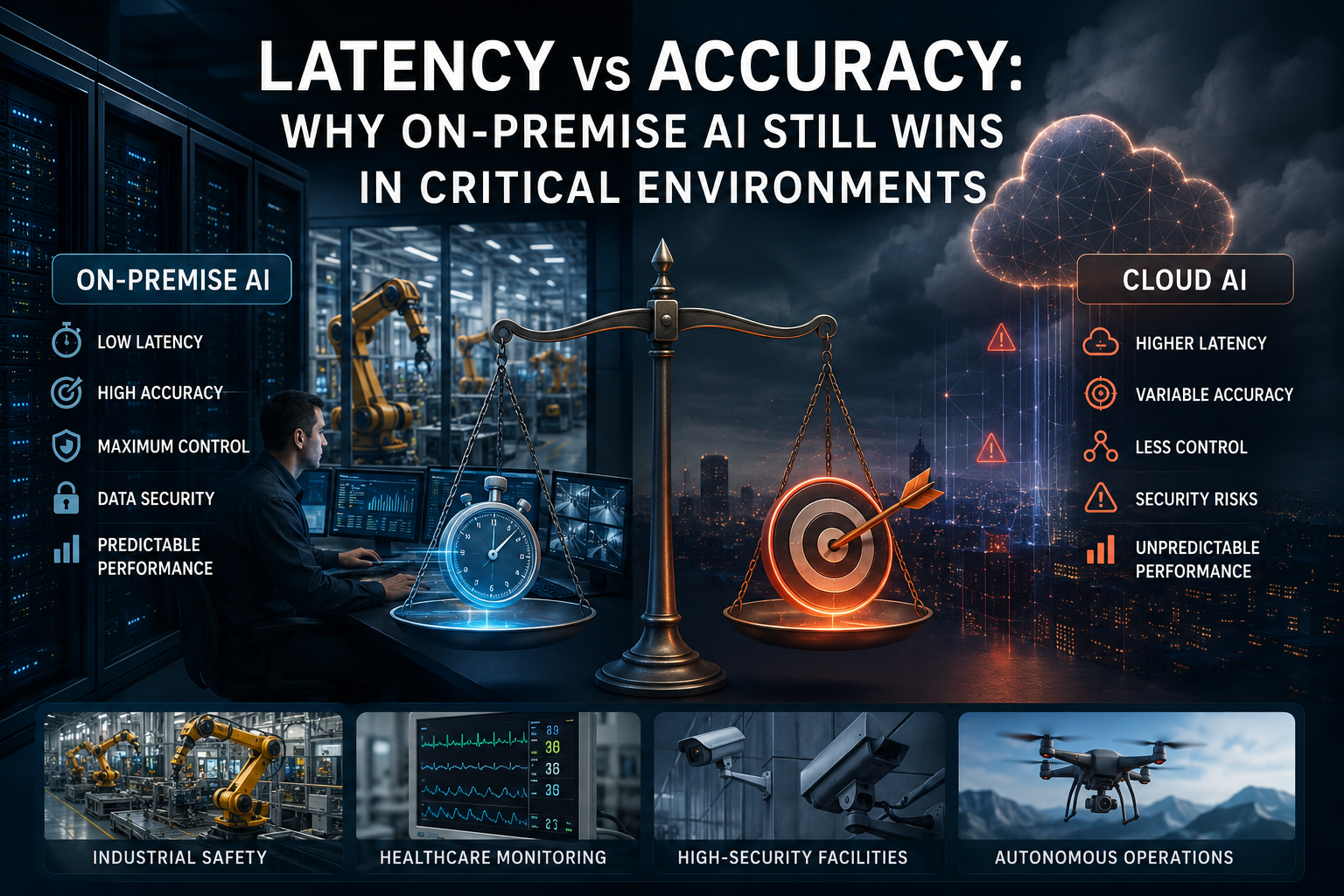
Latency vs Accuracy: Why On-Premise AI Still Wins in Critical Environments
Introduction: The Tradeoff Nobody Wants to Admit
In modern AI conversations, cloud often gets positioned as the default.
It is scalable.
It is flexible.
It is easy to deploy.
But in critical environments, where timing and correctness directly impact safety, compliance, or operations, a different reality emerges:
You are constantly trading between latency and accuracy, and that tradeoff becomes unacceptable faster than most teams expect.
In these situations, on-premise AI is not a legacy choice. It is often the only architecture that can deliver both timely and reliable outcomes.
Understanding the Latency–Accuracy Relationship
Latency and accuracy are usually discussed separately, but in real systems they are deeply connected.
Latency refers to:
- How long it takes for the system to respond
Accuracy refers to:
- How correct that response is
The assumption is:
- Lower latency is always better
- Higher accuracy is always better
But in practice:
- Reducing latency too aggressively can reduce accuracy
- Increasing accuracy often introduces delay
This creates a tension that must be carefully managed.
Why Latency Becomes Critical in Certain Environments
Not all environments treat delay the same way.
In some cases, a delay of a few seconds is acceptable.
In others, even a fraction of a second can have serious consequences.
Examples of critical environments include:
- Industrial safety systems
- Healthcare monitoring setups
- High-security facilities
- Autonomous operational zones
In these contexts:
- Decisions must happen within strict time windows
- Delays directly impact outcomes
Latency is not just a performance metric here. It is a constraint.
The Problem With Remote Processing
When AI processing is performed remotely, several factors introduce delay:
- Data transmission over networks
- Variable network conditions
- Queueing in shared infrastructure
- Multi-tenant resource contention
Even under ideal conditions, these factors create variability.
And variability is what makes systems unreliable.
Why Consistency Matters More Than Peak Performance
A system that responds in 100 ms sometimes and 800 ms at other times is difficult to trust.
Critical environments require:
- Predictable behavior
- Stable response times
- Minimal variance
On-premise systems provide:
- Dedicated resources
- Controlled environments
- Reduced external dependencies
This leads to more consistent performance.
The Accuracy Side of the Equation
Accuracy is not just about the model.
It depends on:
- Input quality
- Processing conditions
- System stability
When processing is remote:
- Data may be compressed or altered
- Timing inconsistencies affect context
- Frame continuity may be disrupted
All of these can degrade accuracy.
Local Processing Preserves Data Fidelity
On-premise AI systems process data close to its source.
This allows:
- Access to higher-quality inputs
- Reduced need for aggressive compression
- Better preservation of temporal continuity
As a result:
- Models receive cleaner, more consistent data
- Outputs become more reliable
The Impact of Network Variability
Networks are inherently unpredictable.
Factors include:
- Congestion
- Packet loss
- Routing changes
- Infrastructure limitations
These introduce:
- Delays
- Data inconsistencies
- Occasional failures
In critical systems, this unpredictability is unacceptable.
On-premise setups remove this dependency.
Control Over Infrastructure
One of the biggest advantages of on-premise AI is control.
Teams can:
- Optimize hardware for specific workloads
- Configure systems for predictable performance
- Monitor and adjust in real time
In contrast, cloud environments:
- Abstract infrastructure details
- Share resources across users
- Limit direct control
This difference becomes significant in high-stakes scenarios.
Real-Time Constraints and Decision Windows
In critical environments, decisions must be made within defined time windows.
If the system responds outside that window:
- The decision may no longer be useful
- The opportunity to act may be lost
On-premise systems reduce:
- Transmission delays
- External dependencies
This helps ensure that decisions occur within required timeframes.
The Hidden Cost of Delayed Accuracy
Accuracy delivered too late is effectively useless.
For example:
- Detecting a safety violation after it has already caused harm
- Identifying an anomaly after the system has failed
In such cases:
- The model may be accurate
- But the outcome is still a failure
This is why latency and accuracy must be considered together.
Resource Isolation and Its Benefits
On-premise systems offer dedicated resources.
This means:
- No competition for compute
- No unpredictable scaling delays
- No interference from other workloads
This isolation improves:
- Performance stability
- Predictability
- Overall system reliability
Security and Data Sensitivity
Critical environments often involve sensitive data.
Examples include:
- Patient information
- Industrial processes
- Security footage
On-premise processing ensures:
- Data remains within controlled boundaries
- Exposure risk is minimized
This is not just a technical advantage. It is often a regulatory requirement.
When Cloud Falls Short
Cloud-based AI systems are powerful, but they are not designed for every scenario.
They excel in:
- Large-scale data aggregation
- Model training
- Non-time-sensitive analytics
They struggle with:
- Strict latency requirements
- High reliability demands
- Environments with limited connectivity
Understanding this distinction is key.
Hybrid Models: A Practical Approach
Many modern systems combine:
- On-premise processing for immediate decisions
- Cloud processing for deeper analysis
This allows:
- Fast local response
- Scalable long-term insights
The key is assigning the right tasks to the right environment.
Common Mistakes Teams Make
Overestimating Network Reliability
Assuming that connectivity will always be stable leads to fragile systems.
Prioritizing Cost Over Performance
Lower upfront costs can result in higher long-term risk.
Ignoring Variability
Focusing on average performance instead of consistency creates blind spots.
Treating All Use Cases Equally
Not every application requires the same level of responsiveness.
A Practical Decision Framework
To decide whether on-premise AI is necessary, consider:
1. Time Sensitivity
How quickly must the system respond?
2. Consequence of Delay
What happens if the response is late?
3. Data Sensitivity
Can the data be transmitted externally?
4. Infrastructure Control
Do you need predictable performance?
5. Environment Stability
Is network connectivity reliable?
The Strategic Insight
The choice between on-premise and cloud is not about technology preference.
It is about aligning system architecture with real-world constraints.
In critical environments:
- Latency is constrained
- Accuracy must be timely
- Reliability is non-negotiable
On-premise AI aligns better with these requirements.
The Future: Distributed Intelligence
The industry is moving toward:
- Systems that combine local and centralized processing
- Architectures that adapt based on context
- Intelligent distribution of workloads
But even in these systems:
- Critical decisions remain local
Because that is where control and predictability exist.
Final Takeaway
Latency and accuracy are not independent goals.
They are part of a single system outcome.
A system that is accurate but late fails.
A system that is fast but wrong also fails.
Critical environments require both:
- Timely response
- Reliable output
On-premise AI provides the foundation to achieve this balance.
Not because it is newer or better, but because it aligns with the realities of how these environments operate.
That is why, despite the rise of cloud computing, on-premise AI continues to hold its ground where it matters most.