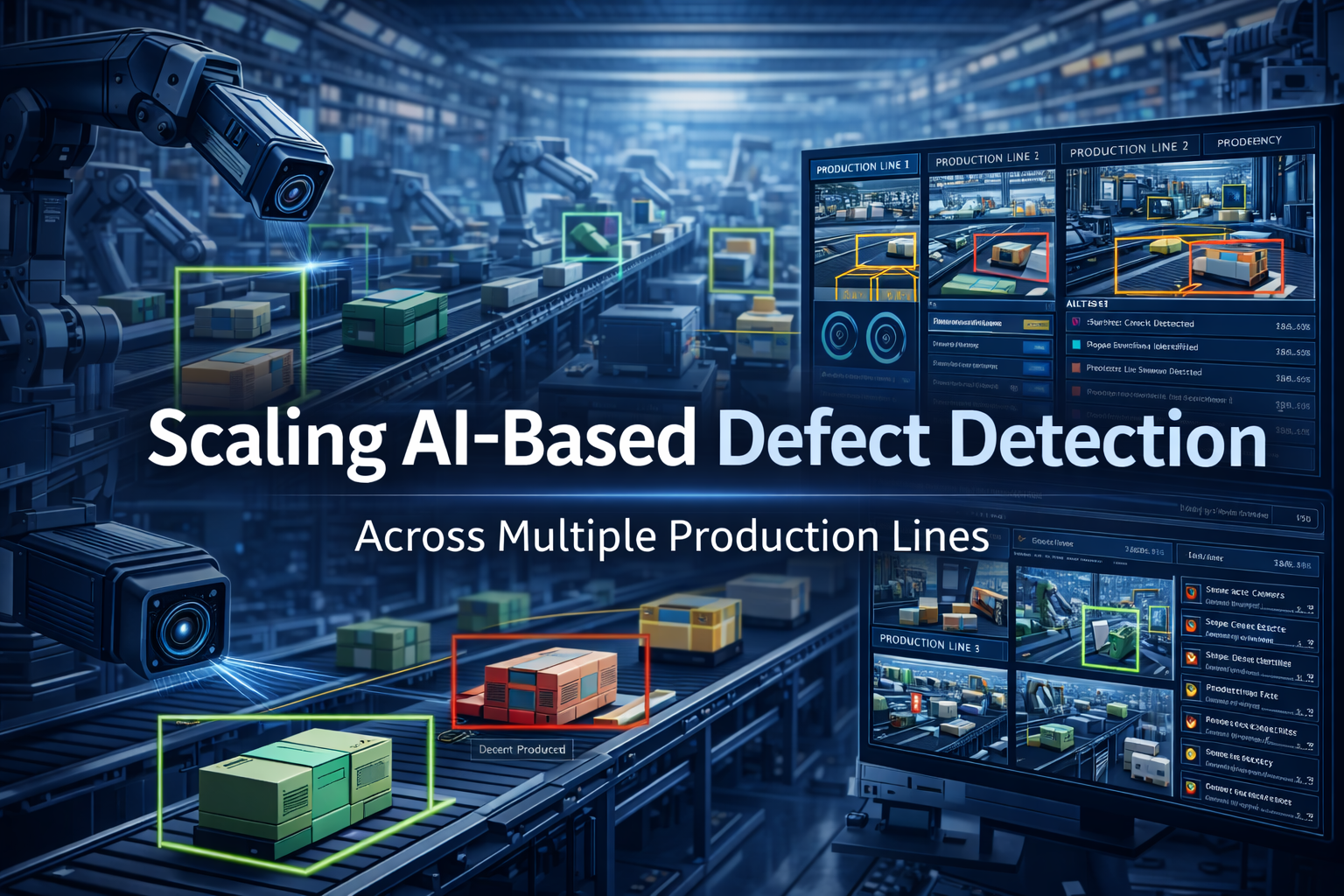
Scaling an AI-based defect detection system Across Multiple Lines
Implementation of an inspection model in a single production line is thrilling. It is like a breakthrough suddenly switches sides, and that which used to pass unnoticed is being intercepted all the time, and good teams are finally seen in a way they never had before.
But that excitement can fade quickly when the next question comes up:
“Can we do this on all our lines?”
This is where things usually get complicated.
Scaling an AI-based defect detection system across multiple production lines isn’t just a bigger version of the first deployment. It’s a different problem altogether. More variables, more people involved, more things that can quietly go wrong.
This article walks through what actually changes when you move from one line to many and how teams can scale without losing accuracy, control, or their sanity.
Why success on one line doesn’t automatically scale
Production lines look similar on paper. In reality, they behave like distant cousins.
Lighting shifts slightly. Cameras vibrate more on one line than another. Operators handle parts differently. Even the same product can present itself at different angles depending on upstream equipment.
An AI-based defect detection system trained on one line is learning more than just defects it’s learning context. As that context shifts, performance may drift slightly but expensively.
That is why the false rejects tend to spike or, worse, defects tend to creep into deployments that are rushed with the intent to copy-paste and get away with it. Scaling requires intention, not duplication.
Standardization: the unglamorous hero of scaling
Before models or infrastructure come into the picture, the biggest wins usually come from standardization.
Using the same camera models, lens types, and mounting distances across lines removes a massive amount of variability. Consistent lighting both placement and color temperature does the same. These details don’t feel strategic, but they save months of tuning later.
Equally important is standardizing how defects are defined. When one team labels a surface mark as “cosmetic” and another calls it “critical,” data becomes fragmented fast. Clear defect definitions and labeling guidelines allow data from different lines to strengthen the same AI-based defect detection system, rather than pulling it in different directions.
Thinking beyond “deployment” with a multi-line deployment strategy
The word “deployment” makes scaling sound like a one-time event. In reality, scaling is ongoing.
A solid multi-line deployment strategy treats each line as part of a larger ecosystem. Inspection happens locally, close to the line, where latency and reliability matter. But visibility, learning, and control live at a higher level.
Most teams land on a hybrid approach. Inference runs at the edge for speed and stability. Model updates, monitoring, and analytics live centrally. This structure keeps production independent while still allowing the organization to learn as a whole.
Without this kind of multi-line deployment strategy, every new line becomes a custom project and that doesn’t scale.
Data grows fast when lines multiply
Adding lines doesn’t just increase throughput. It multiplies data.
A blessing and a burden.
On the bright side, the more lines the more instances of rare defects, the more variation, and the faster the improvement of models. Negatively, uncontrolled data may turn out to be noisy, inconsistent and daunting.
Instead of training highly differentiated models per line, several teams train on a common foundation model, and then tune it with light line-specific tuning. This allows the AI-based defect detection system to learn broadly while still respecting local differences.
Over time, feedback loops matter more than initial training. Samples the model is uncertain about, especially edge cases, should flow back into retraining pipelines. That’s how systems mature instead of plateauing.
Why centralized model management becomes unavoidable
Early on, it’s tempting to manage models manually. One version here, a small tweak there. That approach breaks the moment you scale.
Centralized model management solves problems teams don’t even realise they’re creating. It answers simple but critical questions:
Which model is running on which line?
When was it last updated?
Did performance improve or degrade after the update?
With centralized model management, rolling out improvements becomes routine instead of risky. Teams can test on one line, validate results, then expand confidently. If something goes wrong, rollback is immediate, not a fire drill.
This isn’t just about convenience. It’s about trust in the system.
Managing differences without building one-off systems
No matter how standardized things get, lines will always differ. The goal isn’t to eliminate those differences it’s to accommodate them without fragmentation.
Configuration layers help here. Thresholds, regions of interest, and defect priorities can vary by line while the core AI-based defect detection system remains the same.
This keeps maintenance manageable and ensures that improvements made on one line don’t stay trapped there.
Turning a multi-line deployment strategy into a repeatable process
Scaling fails most often when ownership is unclear.
Quality teams know defects. Operations teams know the line. IT and OT teams know infrastructure. Data teams understand model behavior. A strong multi-line deployment strategy defines how these groups work together instead of stepping on each other.
Successful organisations document everything. Hardware setup. Calibration steps. Acceptance criteria. Performance benchmarks. When a new line is added, the process feels familiar, not experimental.
That repeatability is what turns scaling from a project into a capability.
Monitoring performance across lines (and why it matters)
Once multiple lines are live, performance monitoring becomes less about averages and more about patterns.
A small increase in false rejects on one line might signal a lighting change. A slow drop in accuracy across several lines could point to upstream process drift. Dashboards that compare performance line by line make these signals visible.
When paired with centralized model management, monitoring turns into action. Models improve faster, issues surface earlier, and confidence in the AI-based defect detection system grows
Keeping infrastructure from spiraling out of control
More lines don’t have to mean runaway costs.
Efficient models, optimized inference pipelines, and the right hardware choices keep compute needs predictable. Real-time inspection stays at the edge. Heavy training and analytics stay centralized.
This balance lets organizations scale without constantly re-architecting their stack
What scaling gets you beyond defect detection
When done right, scaling delivers more than fewer defects.
Patterns emerge across lines that no human could spot consistently. Certain defects correlate with specific shifts. Others trace back to supplier variation. The AI-based defect detection system becomes a source of operational insight, not just a gatekeeper.
At that point, quality stops being reactive. It becomes strategic.
Closing thoughts
The concept of scaling to various production lines does not mean adding more cameras or imitating models. It is concerning the creation of a system that learns, changes, and maintains manageability as the complexity increases.
A considered multi-line deployment strategy, standardization and robust centralized model management transform single AI wins into a continuum of value.