
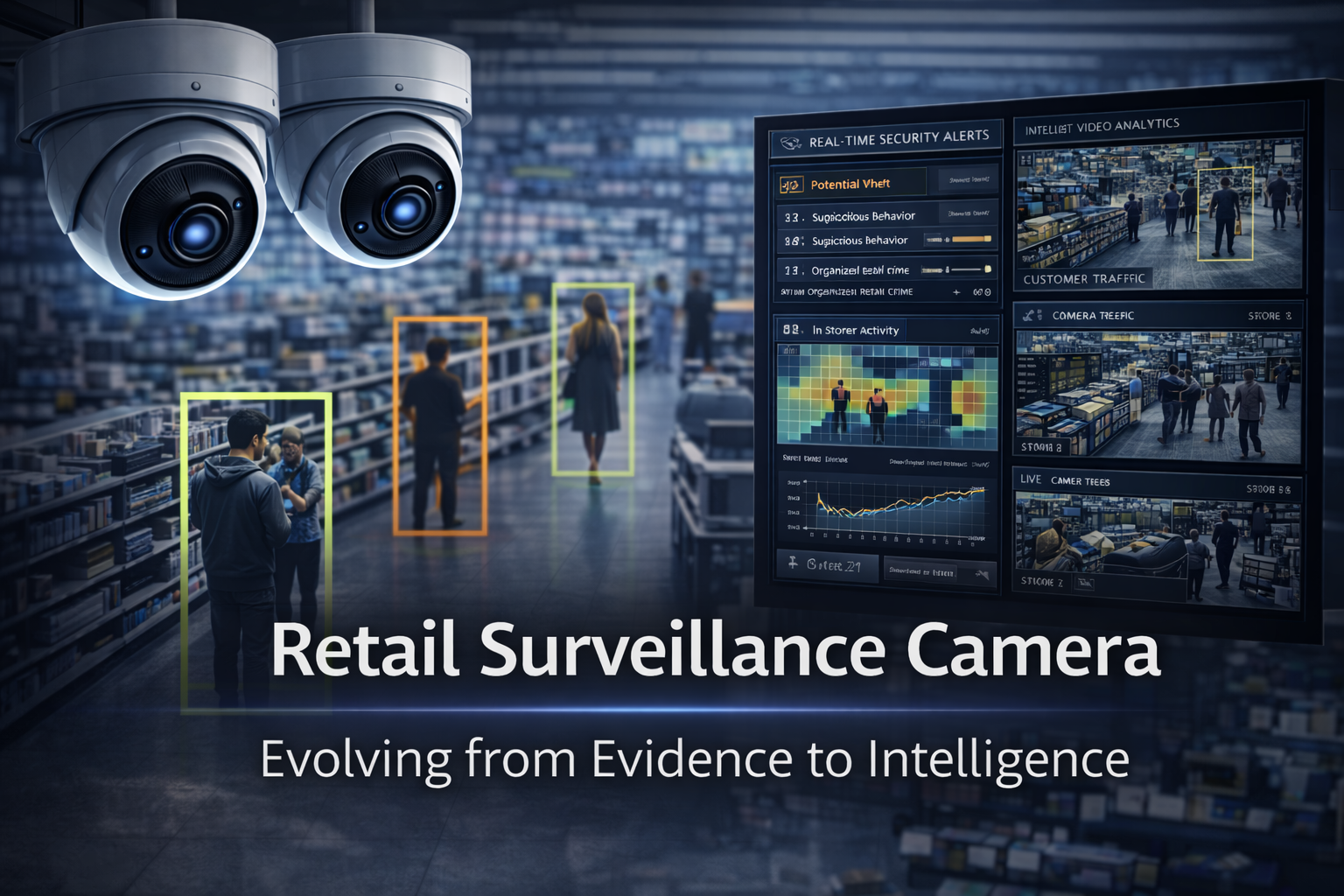
The Retail Surveillance Camera: Shifting from Evidence to Intelligence
Over the decades, retail surveillance cameras have served as passive observers in stores, quietly recording footage that staff typically review only after an incident. Retailers investigate theft, fraud, employee misconduct, or customer disputes retroactively by spending hours reviewing video and manually interpreting events. Although this was an evidence-based approach, it could rarely keep loss at bay in real-time.
Nowadays, that role is quickly changing. The adoption of technologies of artificial intelligence, computer vision, and cloud computing is turning a retail surveillance camera into a complex record-keeping system into a smart business tool. Modern systems do not merely record what has happened, but intend to analyse what is currently happening and forecast what may possibly happen next.
It is this evolution, starting with evidence, to intelligence, that is reshaping the manner in which retailers consider the concepts of safety, operations, and their customer-related experiences.
The Traditional Retail Surveillance Camera Model
The world of surveillance systems in retailing places has long been based on one central goal: documentation. There were cameras that would be placed at entrances, checkout counters, and stockrooms to capture footage at all times. On an eventuality, loss prevention squads would comb through tapes to find evidence.
Although successful in claims insurance or lawsuits, the model had critical limitations:
Reactive, not preventive: Cases were dealt with when they had been lost.
Time-intensive reviews: Video analysis was labour-intensive.
Limited insights: The video provided no extended functional or behavioural intelligence.
The retail surveillance camera, in brief, was a black box, which only became useful once something went awry.
The Rise of Intelligent Video Analytics
The transition commenced with the video analytics that operate AI-powered. Retailers also became capable of automatically interpreting video data by overlaying machine learning models on top of camera feeds.
Modern systems are now able to:
- Identify suspicious behavioural tendencies.
- Monitor movement and dwell time.
- Detect crowding or jostling.
- Identify habitual offenders or suspicious activity.
This transformation has made the retail surveillance camera an active participant in the store activities and no longer a silent observer.
From Monitoring to Proactive Retail Security
The shift toward proactive retail security is one of the greatest consequences of intelligent surveillance. Instead of letting theft or vandalism happen, AI-driven systems detect the indicators of risk when it occurs.
As an illustration, the cameras may be used to indicate the following behaviours:
- Covering movements around high-value goods.
- Hanging around restricted places.
- Abrupt shifts in customer movement patterns.
Through the early detection of these indicators, retailers may prevent damage prior to it happening in a loss-inducing way, whether by involving employees in the process, notifying security guards, or using organisational controls.
This will minimise shrinkage, little frontal security measures, and leave stores safer to both customers and employees.
Real-Time Alerts and Smarter Responses
A characteristic aspect of intelligent surveillance is that it generates real-time alerts retail CCTV systems can use to take immediate action. Rather than spending time going through footage hours or days ago, store managers are notified immediately something is out of the ordinary.
Such alerts may be alerted by:
• Illegal access to back-of-house facilities.
• Sudden formation of crowds near the exits.
After-hours access within the store.
Since information about alerts is provided in near real-time, usually via mobile dashboards or command hubs, retailers have improved reaction times and decisions.
Retailers can minimize the response time and operating blind spots by integrating real-time notifications into retail CCTV solutions with automated processes.
Operational Intelligence Beyond Security
The contemporary retail surveillance camera is not necessarily limited to loss prevention. It is also a great source of operational insights that have direct implications with regard to revenue and customer satisfaction.
AI cameras can scan:
- Traffic of customers during the day.
- Checkout counters queue lengths.
- High-engagement product areas heat maps.
- Customer to staff interaction policies.
The insights enable retailers to optimize stores layouts, staffing plans and merchandising initiatives. In most situations, a single camera system that enhances proactive retail security also enhances operational efficiency.
These two purposes render intelligent surveillance a strategic investment, not a cost centre.
Enhancing the Customer Experience
Surveillance may be linked to security but intelligent systems are increasingly customer-experience oriented. Retailers can better design friendly and engaging stores by knowing how their shoppers move and engage within the store.
An example of what can be detected with a retail surveillance camera is:
- Bottlenecks causing frustration to the shoppers.
- Lingering areas without customer conversion.
- Unoccupied areas of the shop.
Such insights can enable retailers to fine-tune layout, signage, or product placement, and enhance the overall experience of shopping without aggressively collecting data.
Notably, contemporary systems pay attention to behavioral analysis with anonymity, which guarantees privacy but yields practical intelligence.
Cloud Connectivity and Scalable Intelligence
Cloud-based architecture is another major driver of this change. Conventional CCTV systems were hindered by the hard disk storage and hardware capacity. Intelligence can now be extended across hundreds or thousands of locations by cloud-connected cameras, which enable retailers to scale their intelligence.
Cloud platforms enable:
- Multi-store centralized monitoring.
- Consistent AI model updates
- Cross-location performance benchmarking.
- More rapid innovation.
This scaling makes every single retail surveillance camera a node in a broader intelligence system one that is capable of learning and growing more intelligent with time.
Real-Time Decision Making at Scale
Retailers can receive a macro level of retail operations when intelligence is pooled across places. A trend that may remain undetected in one store can be detected around regions or even chains.
As an example, real-time alerts CCTV data can show:
- Local peaks of certain theft strategies.
- Location change in seasonal traffic.
- Store level performance anomalies.
With such information, decision-makers will be able to respond proactively to policies, staffing, or inventory strategies instead of responding to monthly reports.
Compliance, Ethics, and Transparency
Retailers are also dealing with ethical and regulatory issues as surveillance systems increasingly get smart. It is essential to have transparency and data protection and use AI responsibly.
New platforms are being developed with:
- Privacy-by-design.
- Anonymized analytics
- Data regulations in the country.
- Clear governance controls
Intelligent surveillance builds more trust than it destroys when put into practice in a responsible manner.
The Future of the Retail Surveillance Camera
In the future, the retail surveillance camera will extend beyond security and operations. Future systems can be combined with:
- POS and inventory data
- Workforce management tools
- Customer interaction platforms.
This convergence will enable retailers to relate physical behavior and business results in a more direct way than ever before.
With AI models evolving into increasingly advanced levels of technology, surveillance intelligence will move beyond detection to a state of predicting the future to minimise risks, optimise performance, and make strategic choices.
From Evidence to Intelligence: A Strategic Imperative
The metamorphosis of the retail surveillance camera is indicative of an even greater change within the retail field itself, that is, the shift towards reactive management towards real-time and data-driven intelligence.
Retailers who only use footage as evidence run the risk of falling behind. Adopting smart surveillance provides an upper hand to those who engage in safer stores, smarter operations and improved customer experiences.
The retail future is not only observed, but it is also experienced.
Crack down on your surveillance like it is real intelligence, not a mere looky-looseness?
Learn more about VisionBot and how it can enable retailers to access real-time insights and proactive protection- go to https://visionbot.com/