
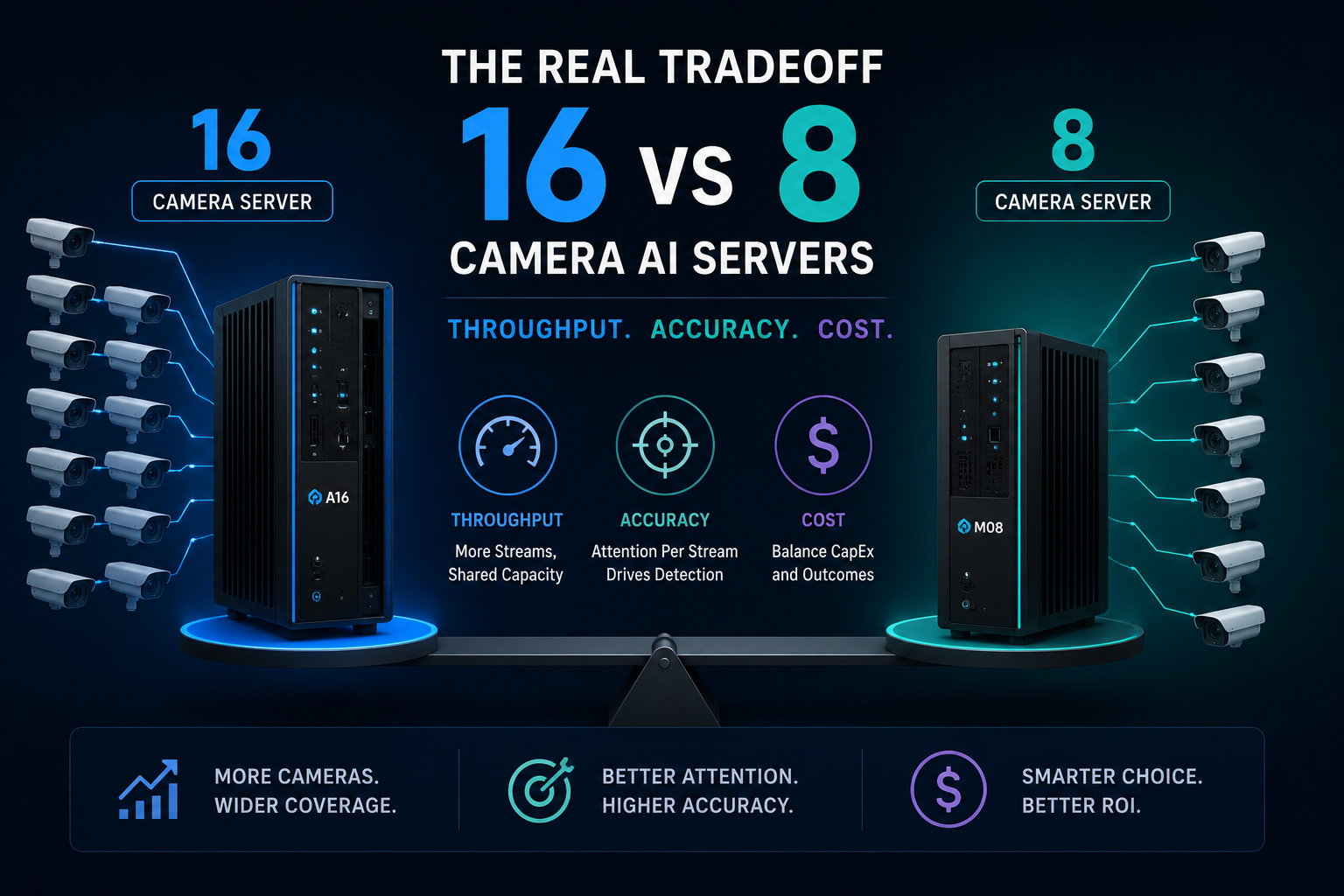
The Real Tradeoff Between 16 vs 8 Camera AI Servers: Throughput, Accuracy, and Cost
When teams evaluate edge AI infrastructure, the conversation often starts with a simple question:
“Should we go with a 16-camera server or an 8-camera server?”
At first, this feels like a sizing problem.
- More cameras → bigger server
- Fewer cameras → smaller server
But this framing hides what actually matters.
Because in video AI systems, you’re not just allocating compute.
You’re allocating attention.
And how that attention is distributed across camera streams determines whether your system is reliable—or quietly failing.
Video AI Is Not About Processing Everything
A common misconception is that video AI systems “analyze all video.”
They don’t.
Even the most advanced systems:
- sample frames
- prioritize certain inputs
- skip large portions of raw data
Why?
Because processing every frame from every camera in real time is computationally expensive.
So every system makes tradeoffs—whether explicitly or not.
What Changes When You Double Camera Count
Let’s consider what happens when you move from an 8-camera setup (M08) to a 16-camera setup (A16).
At a surface level:
- capacity doubles
- hardware capability increases
But at a system level, something more subtle happens:
Each camera gets less consistent attention.
The Attention Distribution Problem
Imagine your AI server as a system that cycles through camera feeds.
With:
- 8 cameras → each stream is revisited more frequently
- 16 cameras → each stream waits longer between processing cycles
Even if total throughput increases, the distribution of that throughput becomes thinner per stream.
Why This Matters
In many real-world scenarios:
- events are brief
- anomalies appear for fractions of a second
- critical signals are not continuous
If your system:
- checks a camera frequently → high chance of catching events
- checks it less often → higher chance of missing them
So the question is not:
“How many cameras can this server support?”
It is:
“How often can this server meaningfully observe each camera?”
Throughput Is Not Capacity — It’s Scheduling
Throughput is often misunderstood as raw power.
But in multi-camera systems, throughput behaves more like a scheduler.
It determines:
- how processing time is divided
- which streams get priority
- how often each feed is analyzed
A16 vs M08 Throughput Behavior
- A16 → higher total throughput, but spread across more streams
- M08 → lower total throughput, but more concentrated per stream
This creates two different system behaviors:
A16 Behavior
- broader coverage
- lower per-stream consistency under load
M08 Behavior
- narrower coverage
- higher per-stream consistency
Accuracy Is a Function of Timing, Not Just Models
Most discussions around accuracy focus on:
- model architecture
- training datasets
But in deployment, accuracy often depends on something more basic:
Timing.
The Timing Gap
If a system processes:
- every 250 milliseconds → high visibility
- every 500–700 milliseconds → reduced visibility
That difference determines:
- whether events are detected
- whether anomalies are missed
Even with the same model.
Real-World Example
Consider a manufacturing line:
- A defect appears for 300 ms
- M08 processes that stream frequently → defect detected
- A16, under load, processes less frequently → defect missed
Same model. Different outcome.
The Illusion of Efficiency
A16 often appears more efficient because:
- it supports more cameras per unit
- reduces hardware footprint
But this efficiency is conditional.
When Efficiency Becomes Dilution
If too many streams compete for compute:
- per-stream processing becomes inconsistent
- detection reliability decreases
At that point:
efficiency turns into dilution
You are covering more ground, but seeing less clearly.
Cost: The Tradeoff Nobody Measures Correctly
Most cost comparisons focus on:
- hardware price
- cost per camera
But these are incomplete metrics.
The Cost That Actually Matters
In operational systems, cost should be measured as:
Cost per reliable detection
Because:
- missed events have consequences
- inconsistent alerts reduce trust
- unreliable systems require manual intervention
The Hidden Cost Curve
A16
- lower cost per camera
- higher risk of missed events (in certain use cases)
M08
- higher cost per camera
- more consistent detection
So the real question becomes:
Are you optimizing for infrastructure efficiency or operational reliability?
Workload Shape Determines the Right Choice
Not all camera workloads behave the same.
Type 1: Continuous Observation Workloads
Examples:
- crowd density
- general surveillance
- traffic flow
Characteristics:
- events are persistent
- missing a few frames doesn’t break outcomes
A16 works well here
Because:
- coverage matters more than precision
Type 2: Intermittent Event Workloads
Examples:
- defect detection
- safety violations
- object misplacement
Characteristics:
- events are brief
- timing is critical
M08 is more reliable
Because:
- higher per-stream attention
The Stability Factor
Another overlooked dimension is system stability under load.
A16 Under Peak Load
- more streams competing
- higher variability in processing
- potential fluctuations in detection consistency
M08 Under Peak Load
- fewer streams
- more predictable performance
- consistent output behavior
Why Stability Matters
In real-world deployments:
- systems don’t operate at ideal conditions
- workloads fluctuate
- network conditions vary
A system that is:
- slightly less efficient but stable
is often more valuable than one that is: - highly efficient but inconsistent
A Better Deployment Strategy
Instead of choosing one model universally, advanced deployments use segmentation.
Split Workloads by Criticality
- Critical streams → M08
- Non-critical streams → A16
Example
In a warehouse:
- Loading dock cameras (high importance) → M08
- general area monitoring → A16
Result
- accuracy where it matters
- efficiency where it’s acceptable
The Role of System Design
This decision is not isolated.
It connects to:
- ingestion (S06)
- cloud analytics
- storage (Cloud NVR)
A well-designed system:
- balances load
- routes intelligently
- avoids overloading any single layer
The Real Decision Framework
Instead of asking:
“Which server is better?”
Ask:
1. How sensitive are my events to timing?
- high → fewer cameras per server
2. What is the acceptable miss rate?
- low tolerance → prioritize consistency
3. Is my workload continuous or intermittent?
- continuous → A16
- intermittent → M08
4. Do I need uniform performance or optimized performance?
- uniform → M08
- optimized mix → hybrid
Final Insight
The difference between 16-camera and 8-camera servers is not just scale.
It’s how attention is distributed across your system.
Because in video AI:
- you are not just processing data
- you are deciding what gets seen, and what gets missed
And that decision defines system effectiveness.
Design the Right Edge AI Deployment with VisionBot
Choosing between A16 and M08 isn’t about picking a bigger or smaller server, it’s about designing a system that aligns with how your operations actually behave.
VisionBot enables this with a complete stack:
- A16 & M08 Edge AI Servers → tailored for different workload profiles
- Streaming Gateway (S06) → ensures stable, optimized ingestion
- Cloud Hosted Platform → centralized analytics and insights
- Cloud NVR → scalable and secure storage
Whether your priority is coverage, precision, or a balance of both, VisionBot helps you architect deployments that perform reliably in real-world conditions, not just on paper.
Explore VisionBot’s solutions or request a demo to design a system optimized for your specific use case.