
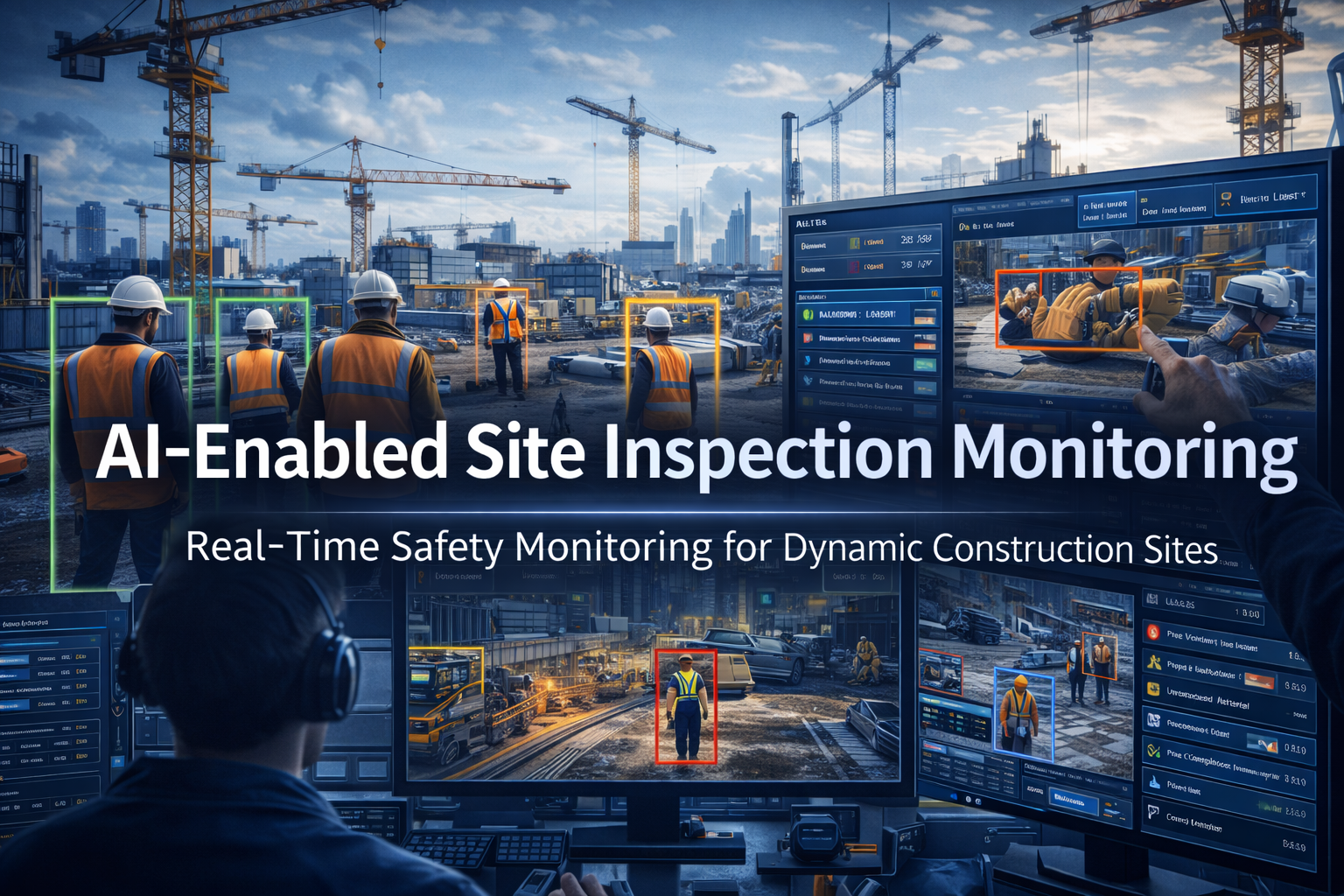
AI-enabled site inspection monitoring for Dynamic, Uncontrolled Sites: What Actually Works on the Ground
Everyone who has ever worked on a live construction or industrial location is aware of one thing no two days are ever exactly alike. The layouts shift, the crews switch, equipment will relocate, and risks will manifest themselves in areas where they seemed to be safe a few hours before. Under such circumstances, periodic manual inspections tend to seem like striking a moving target.
It is precisely why AI-enabled site inspection monitoring is becoming increasingly popular in the construction, infrastructure, and heavy industry. Not as a buzzword, but as a pragmatic reaction to the fact of dynamic, unregulated sites in which traditional control can find no way to keep abreast.
This article provides a pragmatic examination of the role of AI-led inspection observation within the environment of the actual sites, its significance, and the areas where it can provide tangible value.
The Reality of Dynamic, Uncontrolled Sites
Uncontrollable sites are not unsafe on purpose, it is unsafe by nature. These habitats are changing regularly:
- Structures emerge and evolve from.
- The momentary access points appear and disappear.
- New subcontractors come during the project.
- Weather and visibility change randomly.
Safety plans can be comprehensive, but situations hardly remain consistent with those plans over time. Even seasoned safety teams find it difficult to exercise a steady level of control when the site itself continues to redefine its own rules.
Here is where AI-enabled site inspection monitoring starts to seem not so much of a technology but an additional pair of constantly-on eyes.
Why Manual Inspections Aren’t Enough Anymore
Traditional site inspections still matter. Walkthroughs, toolbox talks, and audits play an essential role. But they also come with unavoidable limits:
- Inspections happen at intervals, not continuously
- Unsafe behavior can occur minutes after an inspection ends
- Human observers miss things, especially on large or crowded sites
- Scaling inspections across multiple locations is expensive
On fast-moving sites, gaps between inspections are often where incidents happen. AI doesn’t replace human judgment, but it fills those gaps with constant awareness.
How AI-enabled site inspection monitoring Fits into Daily Operations
At the practical level, AI-enabled site inspection monitoring involves cameras and computer vision models that observe the activity on the site in real time. These systems are conditioned to identify conditions and behaviour that are of safety and compliance concern.
As opposed to the passive existence of recording footage, the system is the one that actively processes the footage it is observing and notifies of hazards, unsafe acts, and violations of the rules as they occur.
This stream of ongoing monitoring operates silently in the background and aids the safety teams instead of overwhelming them.
Turning Observation into Prevention
Making safety reactionary to preventive is one of the largest changes that AI will introduce.
When the data of inspection is recorded continuously, it begins to exhibit patterns:
- Certain zones show repeated safety violations
- Specific tasks correlate with higher risk
- Certain times of day see more unsafe behavior
This insight is particularly valuable in construction site safety monitoring AI, where understanding when and where risks arise is just as important as knowing what they are.
Over time, construction site safety monitoring AI helps teams focus effort where it actually reduces incidents, not just where it’s easiest to inspect.
PPE Compliance Without the Confrontation
Personal Protective Equipment remains one of the simplest and most ignored safety requirements on job sites. Helmets come off, vests get skipped, and compliance often depends on who’s watching.
With AI, PPE compliance becomes consistent rather than confrontational.
PPE detection construction systems can be used to monitor the absence of helmets, safety vests, gloves, or masks in real time, which allows them to be detected when a worker enters a policed zone without the necessary equipment.
PPE detection construction permits instantaneous alerts and remedial measures rather than the supervisor noticing that unsafe behaviour has become commonplace.
Why AI is an Ideal Fit on Controlled Sites
The environment is uncertain and uncontrolled, although AI is made by variability. In contrast to the systems based on strict rules, the contemporary AI models are able to adjust to the new layouts, lighting conditions, and site configurations.
This is particularly effective when it comes to AI-enabled site inspection monitoring and where the processes are fixed and fail. The system does not make assumptions about what the site looks like today that it was like the day before it knows what to learn.
This flexibility is a significant strength in projects where there is high turnover, or rotating crews, or when the contractors are overlapping.
Scaling Safety Without Scaling Headcount
One of the less discussed benefits of AI inspection systems is scalability. Dashboards and alerts can help one centralized team to monitor many sites in contrast to the physical presence at each site.
This is where the AI-enabled site inspection monitoring help resolve one significant operational dilemma of ensuring safety levels in distributed or large-scale projects without continually increasing the number of inspection personnel.
Rather than increasing the number of boots on the ground, organizations can have a better view of the ground they already cover.
Data That Actually Helps Decision-Making
AI systems do not merely create alerts; they create a record. In weeks and months, this information is a potent tool in planning.
Safety leaders can see:
- Which hazards appear most often
- Which areas need redesign or additional controls
- Which subcontractors require extra training
This data-driven feedback loop is something manual inspections struggle to provide. And in long-term deployments of AI-enabled site inspection monitoring, it often becomes one of the most valuable outcomes
Addressing Worker Trust and Transparency
Any monitoring technology raises questions, especially around privacy. The most successful deployments address this head-on.
Best practices include:
- Monitoring safety conditions, not individual identities
- Communicating clearly why AI is being used
- Positioning the system as protection, not punishment
When implemented responsibly, AI inspection tools are often welcomed by workers, particularly when they see incidents drop and interventions become more consistent.
Where Site Inspection Is Heading Next
Site inspection in the future is not only about identifying issues, it is also about anticipating them. As AI models become more mature, the system will be able to predict high-risk situations before they happen.
Together with drones, wearables and IoT sensors, AI-enhanced site inspection monitoring is evolving into a proactive safety intelligence layer, capable of adapting as quickly as the site itself.
Final Thoughts
Uncontrolled dynamic sites are not becoming easier. Projects are bigger, deadlines shorter, and the standards of compliance are higher. It is no longer sufficient to manage these environments by only conducting periodic inspections.
As it provides consistent visibility, actionable insights, and predictable implementation of safety standards, AI-enabled site inspection monitoring could represent a viable solution to the problem, and it does not displace safety teams but assists them.
Advanced construction site safety monitoring AI to real-time PPE detection construction AI is becoming an indispensable part of smarter and safer site operations.
Ready to make site inspections smarter, not harder?
Watch VisionBot assist a team to continually monitor safety even on the most active sites. https://visionbot.com/