
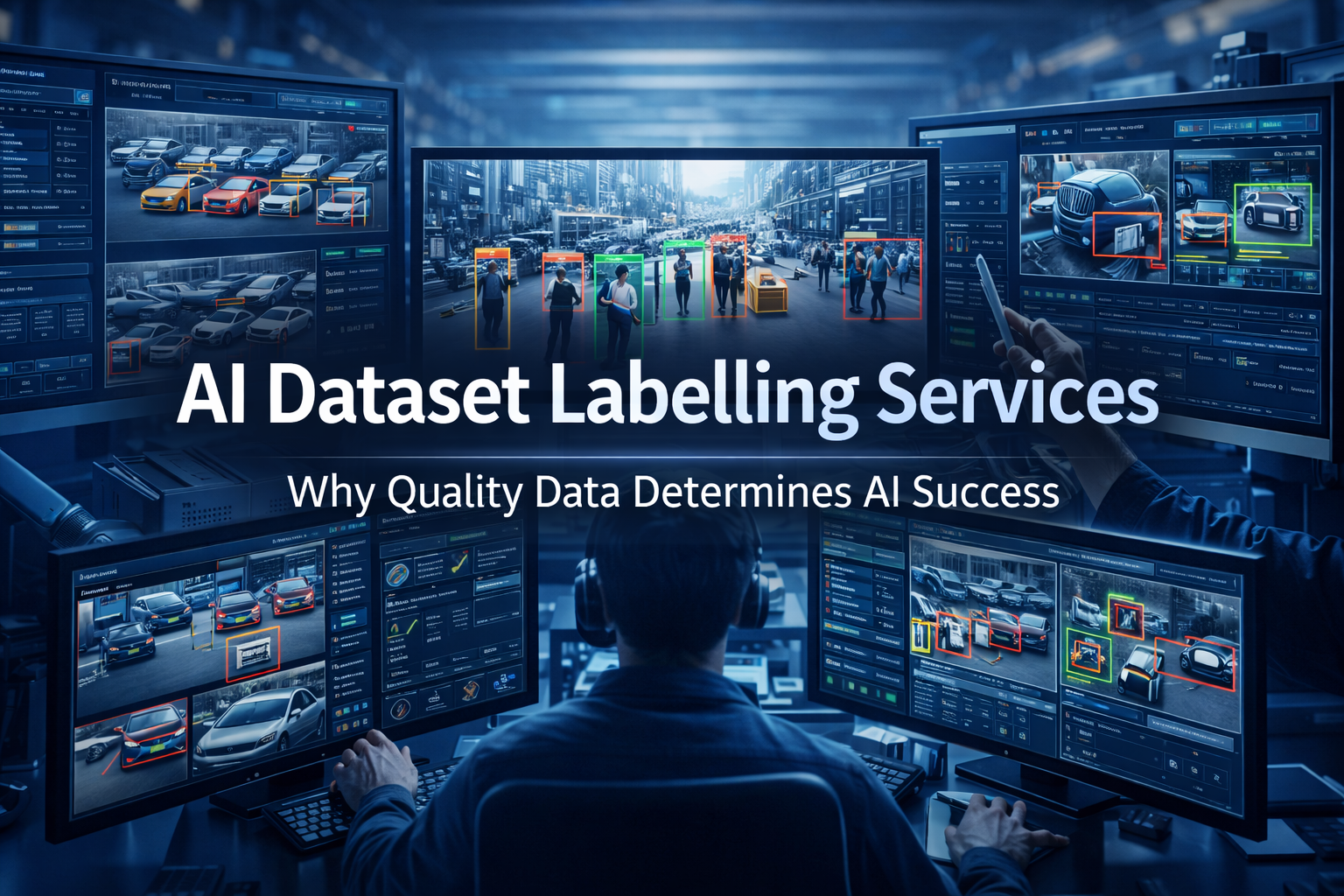
Why AI Dataset Labelling Services Decide Whether Models Actually Work in the Real World
An AI model that performs well in a demo and one that performs well in the wild can vary by a great margin.
Most teams have experienced this at least once: the model performs well in testing, delivers impressive accuracy scores, wins over stakeholders, and then enters production. Suddenly, predictions feel off. Edge cases pile up. Users lose trust.
When it occurs, the immediate thought process is to make any adjustment to the model. Yet more frequently than not, the actual problem lies much further up river.
It’s the data.
More specifically, it’s the labels.
This is why AI dataset labelling services quietly determine whether AI systems succeed or fail in the real world.
Why “Good Enough” Labeling Isn’t Good Enough Anymore
Labeling is often treated as a checkbox task, something that needs to be done before the “real” AI work begins. But that mindset is exactly what causes models to fall apart later.
Every label tells the model what reality is supposed to look like. If those labels are inconsistent, rushed, or misunderstood, the model doesn’t learn “almost right.” It learns wrong.
That’s where professional AI dataset labelling services make a real difference. They don’t just label faster, they label with intention, consistency, and context.
And context matters far more than most teams expect.
Models Don’t See the World, They Inherit It
AI systems don’t reason the way humans do. They absorb patterns from labelled data and assume those patterns reflect reality.
So when:
- A pedestrian is sometimes labelled and sometimes ignored
- Objects are boxed differently by different annotators
- Rare cases are skipped because they’re “too hard”
The model doesn’t know these are mistakes. It assumes they’re rules.
This becomes especially obvious in data annotation for computer vision, where tiny inconsistencies can completely change how a system understands a scene.
Strong AI dataset labelling services act as the interpreter between the real world and the model, making sure the version of reality being taught is actually accurate.
Data Annotation for Computer Vision Needs Human Judgment
Vision data is messy. Objects overlap. Lighting changes. Angles distort perception. Real environments are nothing like clean datasets.
That’s why data annotation for computer vision can’t be handled well by automation alone.
You need people who understand:
- What should be labelled versus what can be ignored
- How to handle partial visibility
- Why two similar-looking objects shouldn’t always share the same label
Experienced AI dataset labelling services train annotators to think in scenarios, not just shapes and tags. That’s what helps models perform reliably outside controlled environments.
Why Labeling QA and Audits Are Where Accuracy Is Won or Lost
Even the best annotators make mistakes. The difference between average and excellent datasets isn’t perfection it’s correction.
This is where labeling QA and audits matter more than speed or scale.
Effective labeling QA and audits catch problems like:
- Concept drift over time
- Conflicting interpretations across teams
- Systematic bias in certain label categories
Without QA, these issues compound quietly until they surface as “mysterious” accuracy drops in production.
High-quality AI dataset labelling services don’t treat QA as a final step. They build it into every stage of the workflow.
Real-World AI Fails for Very Human Reasons
When AI systems fail in production, the causes are rarely exotic:
- Someone misunderstood a guideline
- An edge case was skipped to save time
- Quality checks were rushed to meet a deadline
These are human problems and they need human-aware systems to prevent them.
That’s why mature AI dataset labelling services focus as much on process design as they do on throughput. Clear instructions, feedback loops, and structured reviews reduce errors long before a model ever sees the data.
Scaling AI Does Not Break Accuracy
The larger the datasets, the more difficult it is to be consistent. New annotators join. Guidelines evolve. Prior assumptions quietly change.
Without structure, accuracy slowly erodes.
Professional AI dataset labelling services prevent this by:
- Maintaining stable labeling ontologies
- Running continuous labeling QA and audits
- Reviewing samples across time, not just batches
This makes the large datasets maintain their coherence, meaning that models that have been trained using millions of samples do not act randomly but rather predictably.
Why Human-in-the-Loop Wins Still
Fully automated labelling overcomes ambiguity and judgment calls in spite of advances in automation.
Human-in-the-loop systems are notable due to their ability to provide speed and insight, particularly in data annotation for computer vision, often where subtlety is a necessity.
The most reliable AI dataset labelling services don’t replace humans; they amplify them with better tools, smarter workflows, and stronger QA.
Labels Decide Trust, Not Just Accuracy
The metrics of accuracy matter, but trust is what keeps AI systems running in the production.
Users check out when forecasting is not reliable. When outputs don’t match reality, teams lose confidence. And when trust is gone, models get abandoned even if they’re technically “accurate.”
That’s why investing in AI dataset labelling services isn’t about optimization it’s about building AI systems people are willing to rely on.
Conclusion
AI models do not fail because they are not intelligent enough. Their failure is because they did not get the right lessons.
Strong AI dataset labelling services ensure that models learn from data that reflects the real world with all its complexity, edge cases, and imperfections.
If your AI needs to work outside a demo environment, labeling isn’t optional. It’s foundational. If you’re serious about real-world AI performance, start with better data.
Explore expert-led AI dataset labelling services at https://visionbot.com/ and build models that hold up in production.