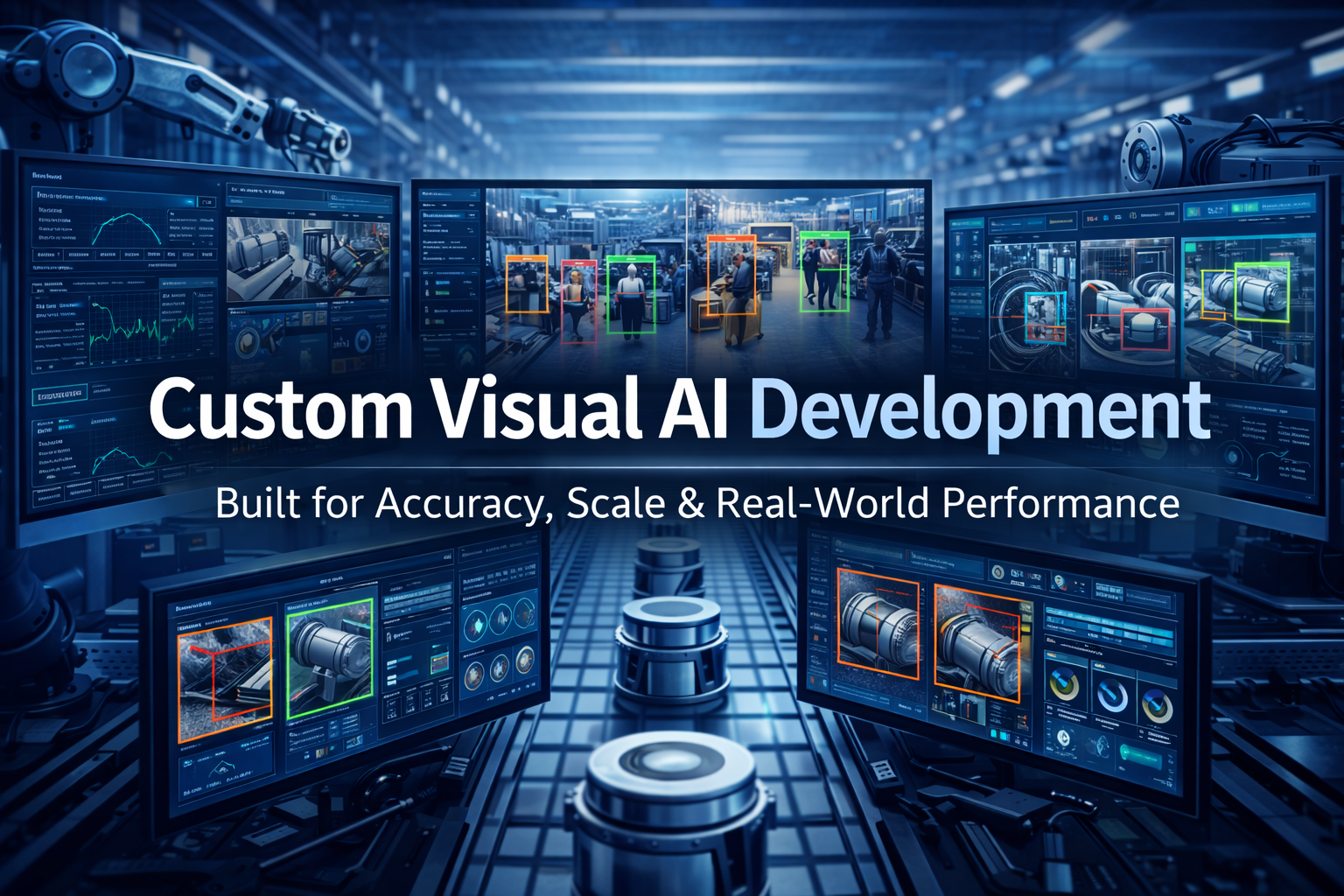
Custom visual AI development for Businesses That Need Accuracy and Scale
Visual AI is everywhere right now. Since it was first used to detect malfunctions on factory production lines, computer vision has become the silent yet valuable workhorse of numerous modern companies, whether it be what is on the shelf of a particular store or within the confines of a medical scan.
But, when teams decide to use visual AI, they are likely to arrive at the same crossroad:
Is it better to take an off-the-shelf model or make our own?
Off-the-shelf models are fast, inexpensive, and easy to test. But when accuracy, reliability, and real-world complexity enter the picture, many organisations discover their limits pretty quickly. That’s when Custom visual AI development starts to make a lot more sense.
Let’s break down when and why building custom visual AI is the smarter move.
The popularity of off-the-shelf visual AI in the early days.
Ready-made visual AI models will be capable of solving general problems, i.e., detect objects in images, classify or recognize faces. They are trained on public large datasets and can be accessed via API or SDKs.
They’re popular because they:
- Get you started fast
- Require little AI expertise
- Cost less upfront
They can surely do the job with demos, MVPs, or generic use cases. However, when you go beyond experimentation and start production, things are different.
Where Off-the-Shelf Models Begin to Fail
The reality is that off-the-shelf models are meant to fit anyone and that is to say they are not meant to fit you.
They struggle when:
- Your images don’t look like “standard” images
- You need to detect subtle or rare visual patterns
· Your surroundings alter (lighting, angles, noise)
· Precision refers to a direct effect on revenue, safety or compliance.
As these models are trained using generalised data, they lose context that is most significant in the real world.
When Custom visual AI development Is the Smarter Choice
1. Your Visual Problem Is Highly Specific
If you’re working with specialized images industrial parts, medical scans, aerial imagery, or agricultural fields generic models usually aren’t enough.
At this point, having a custom object detection model would be invaluable. Training the model on your own images helps you to condition the model to identify what in your domain is important and not what was important in a different dataset.
The result? Less fake alarms, greater accuracy, and knowledge you can really rely on.
2. Your Environment Is Messy (Like the Real World)
Most real-world environments are unpredictable. Lighting changes. Cameras vibrate. Objects overlap. Weather interferes.
Off-the-shelf models don’t adapt well to these conditions. Custom-built models do because they’re trained on data collected from your real operating environment.
That’s one of the biggest advantages of Custom visual AI development: performance that holds up when things aren’t perfect.
Accuracy Isn’t Just a Number, It’s Business Impact
Even a few percentage points of difference may not seem much, but in production systems, it can be everything.
- In the manufacturing industry, it may decrease downtime
- In logistics, it can prevent costly misclassification
- In healthcare, it can support better clinical decisions
Custom models are optimised around your business goals, not benchmark scores. And that focus often translates directly into ROI.
Faster Customization With transfer learning for vision
One common concern is that custom AI takes too long or costs too much. That used to be true but not anymore.
With transfer learning for vision, teams don’t start from scratch. Rather, they train the existing pre-trained models on their own data. This significantly shortens the training time and data requirements.
You have the best of both worlds:
· The speed of existing AI foundations
- The precision of domain-specific learning
This approach is one reason Custom visual AI development has become far more accessible in recent years.
Data Control, Privacy, and Compliance Matter More Than Ever
Visual data is often sensitive. Think patient images, factory footage, or security feeds. Sending that data through third-party systems isn’t always an option.
Custom solutions give you full control:
- Where your data lives
- How models are trained
- How predictions are generated
For regulat industries, this control isn’t just nice to have, it’s essential.
Scaling Beyond the First Use Case
Off-the-shelf models tend to be constructed with a limited task. It can be frustrating or even impossible to expand them to deal with new objects, new places, or new workflows.
Custom systems are different. They’re designed to evolve.
A custom object detection model is a robust model that can be expanded over time, new classes included, new data included, and performance constantly enhanced. Such versatility will ensure that custom AI remains a long-term investment, as opposed to a short-term solution.
transfer learning for vision and Long-Term Value
Another benefit of transfer learning for vision is future-proofing. As your dataset grows, your models get smarter. Each iteration improves accuracy and resilience, creating a compounding advantage.
This means your visual AI system doesn’t just stay relevant, it gets better with age.
Cost: Seeing Past the Surface Price
Yes, off-the-shelf models are less expensive to begin with. But they usually have an underground price:
- Licensing fees
- Integration limitations
- Accuracy issues that affect operations
Bespoke AI can be more expensive at first, yet it tends to pay back in improved performance, reduced error rates, and enhanced differentiation.
In cases where visual AI form the bulk of your business, short-term gains hardly measure up against long-term worth.
Is Custom visual AI development Right for You?
Custom solutions make the most sense when:
- Accuracy really matters
- Your visual data is unique
- You need scalability and control
- AI is a competitive advantage, not an experiment
If your use case is simple, off-the-shelf models are a fine starting point. However, when visual intelligence takes the center stage of your operations, then it would be wiser to customize.
Conclusion
The decision whether to use pre-made or homemade visual AI is not only a technical choice, but also a strategic choice.
Ready-made models prove to be excellent when starting out. But when your business depends on reliable, real-world visual understanding, Custom visual AI development gives you control, accuracy, and flexibility that generic tools simply can’t match.
Looking to build visual AI that actually works in the real world?
Explore tailored computer vision solutions designed around your data and goals at https://visionbot.com/