
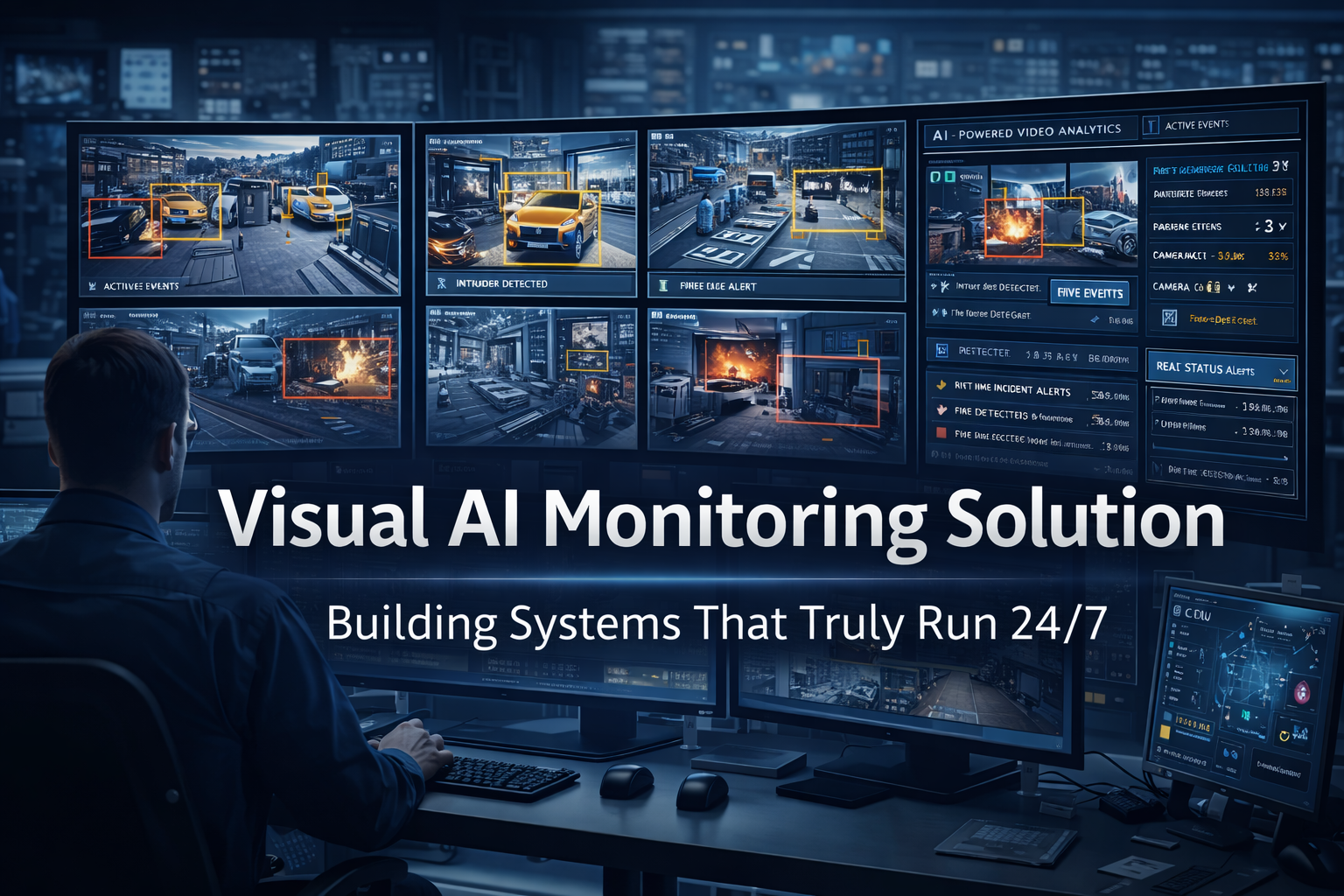
Building a Visual AI monitoring solution That Truly Runs 24/7
No matter whether you have used cameras to monitor a room, you must have realized an inconvenient truth: video alone does not guarantee awareness. The cameras record everything yet they understand nothing. Operators still have to watch, interpret, and respond, and even the most skilled humans can’t stay alert 24/7.
And that is where a Visual AI monitoring solution comes in. It is not just a passive receiver of footage, but rather an active interpreter of what is going on, what is important, and what continues even when people have left. However, creating a system that actually operates twenty-four hours is not as straightforward as connecting an AI model and wishing it the best.
Here, we will step through what it would really require in practice and in reality to create a visual AI system that does not blink, stall, or silently fail at 3 am.
Why “Always On” Has Become a Real Requirement
The price of wasted moments is increasing across industries. When teams overlook a safety incident, detect a security breach too late, or uncover a compliance issue after the fact, the consequences can be severe.
That is why an increasing number of organisations are shifting to a Visual AI monitoring solution instead of traditional video surveillance. AI systems do not experience fatigue. It does not lose concentration on night shifts. And it does not fail to see those little patterns humans frequently overlook.
Nevertheless, the pressure is high and uncompromising. A system that claims to be 24/7 must deliver. That means no silent outages, no delayed alerts, and no reliance on perfect conditions.
What Makes a 24/7 Visual AI monitoring solution Work in the Real World
On paper, most visual AI platforms look similar. In practice, the ones that last are built with failure in mind.
A dependable system usually includes:
- Continuous video ingestion that can handle unstable networks
- Edge-based inference so decisions happen close to the camera
- Centralized control for updates, analytics, and visibility
- Alerting mechanisms that integrate into real workflows
What separates a demo from production is resilience. This is where high availability video analytics becomes essential, not optional.
Why high availability video analytics Is Non-Negotiable
When systems go down, they rarely announce it loudly. A frozen stream, a stalled process, or a crashed edge device can go unnoticed for hours.
That’s dangerous.
True high availability video analytics means designing for the assumption that something will fail. Hardware breaks. Networks drop. Software crashes. The system must absorb these hits and keep running.
Some practical strategies that actually help:
- Redundant edge nodes so one failure doesn’t stop inference
- Automated health checks with self-restarts
- Load distribution across devices and regions
- Clear fallback behavior instead of total shutdown
The goal isn’t perfection. It’s continuity
Edge AI Isn’t Optional Anymore
Sending every video stream to the cloud sounds convenient until latency, bandwidth costs, and outages get in the way. For systems that need to respond instantly, relying solely on the cloud just doesn’t hold up.
Edge AI changes that. By processing video near the source, a Visual AI monitoring solution can detect issues and trigger alerts immediately, even if connectivity is limited.
Cloud platforms still matter, of course. They are perfect with centralised analytics, model management and historical insights. The best systems are the most reliable ones that balance real-time edge decisions and long-term cloud intelligence.
This hybrid model also enhances the high availability video analytics, as the edge devices are capable of operating autonomously when there is an interruption in cloud access.
Keeping AI Accurate Over Time (Not Just on Day One)
AI models don’t fail loudly. They fail quietly by slowly becoming less accurate.
Lighting changes. Cameras shift. Environments evolve. Without maintenance, even strong models degrade. A truly reliable Visual AI monitoring solution accounts for this reality.
That means:
- Monitoring model performance continuously
- Training on new, actual information.
- Adaptive thresholds, rather than strict rules.
- Introducing changes step by step, rolling back.
Stability over time is more important than flashy accuracy at launch.
The Often-Ignored Risk: cybersecurity for edge AI
Edge devices are powerful but they’re also vulnerable. Many sit in remote or physically accessible locations, making them attractive targets for attackers.
Strong cybersecurity for edge AI isn’t just about protecting data. It’s about protecting operations.
Best practices that make a real difference include:
- Secure boot and device authentication
- Encrypted video streams and metadata
- Regular patching and firmware updates
- Network isolation between devices
Without adequate cybersecurity for edge AI, can be a weak layer in a more substantial security system.
Privacy, Compliance and Doing This the Right Way
Always-on monitoring raises understandable concerns. People want to know how footage is used, stored, and protected and they should.
A responsible Visual AI monitoring solution bakes privacy into the design rather than treating it as an afterthought.
That often includes:
- Masking or anonymizing sensitive data
- Configurable retention policies
- Clear audit logs
- Alignment with regional regulations
Done right, visual AI can improve safety and efficiency without crossing ethical lines.
Scaling Without Losing Control
Many teams start small a single site, a handful of cameras. Then success leads to expansion. Suddenly, dozens or hundreds of locations need to be managed consistently.
Scalable systems share a few traits:
- Centralized model and configuration management
- Automated onboarding for new cameras
- Standardized deployment templates
- Cloud-native infrastructure that grows on demand
A scalable Visual AI monitoring solution grows quietly in the background, without constant manual intervention.
How to Check if It Really Works
The systems that are always-on are not cheap and they should not be hyped up with promises of vagueness. The value can be made understandable by measuring the right things:
- Faster incident detection and response
- Fewer missed events
- Reduced dependence on manual monitoring
- Better safety and compliance results
When such metrics shift the right way, the system deserves its spot.
Moving Forward: The Future of Visual AI
Visual AI is no longer reactive but contextual. The systems of the future will not only know what occurred, but why the occurrence is significant. The edge hardware developments, federated learning, and autonomous recovery will ensure 24/7 monitoring is more intelligent and reliable.
Companies investing in a powerful Visual AI monitoring solution today are not merely addressing the current issues. They are planning their future when visual intelligence will be a layer of operation.
Final Thoughts
It is difficult but possible to run a visual AI system 24/7. It demands considerate design, pragmatic anticipations, high availability video analytics, and earnest consideration regarding cybersecurity of edge AI.
When all of these elements are put together, visual AI ceases to be merely an instrument. It is made a silent partner who observes, comprehends, and helps function around the clock with each hour of each day.
Want to go beyond the rudimentary surveillance?
Learn why VisionBot is used by teams to develop scalable, secure, and 24/7 visual intelligence systems.
Visit visionbot.com to have a look.