
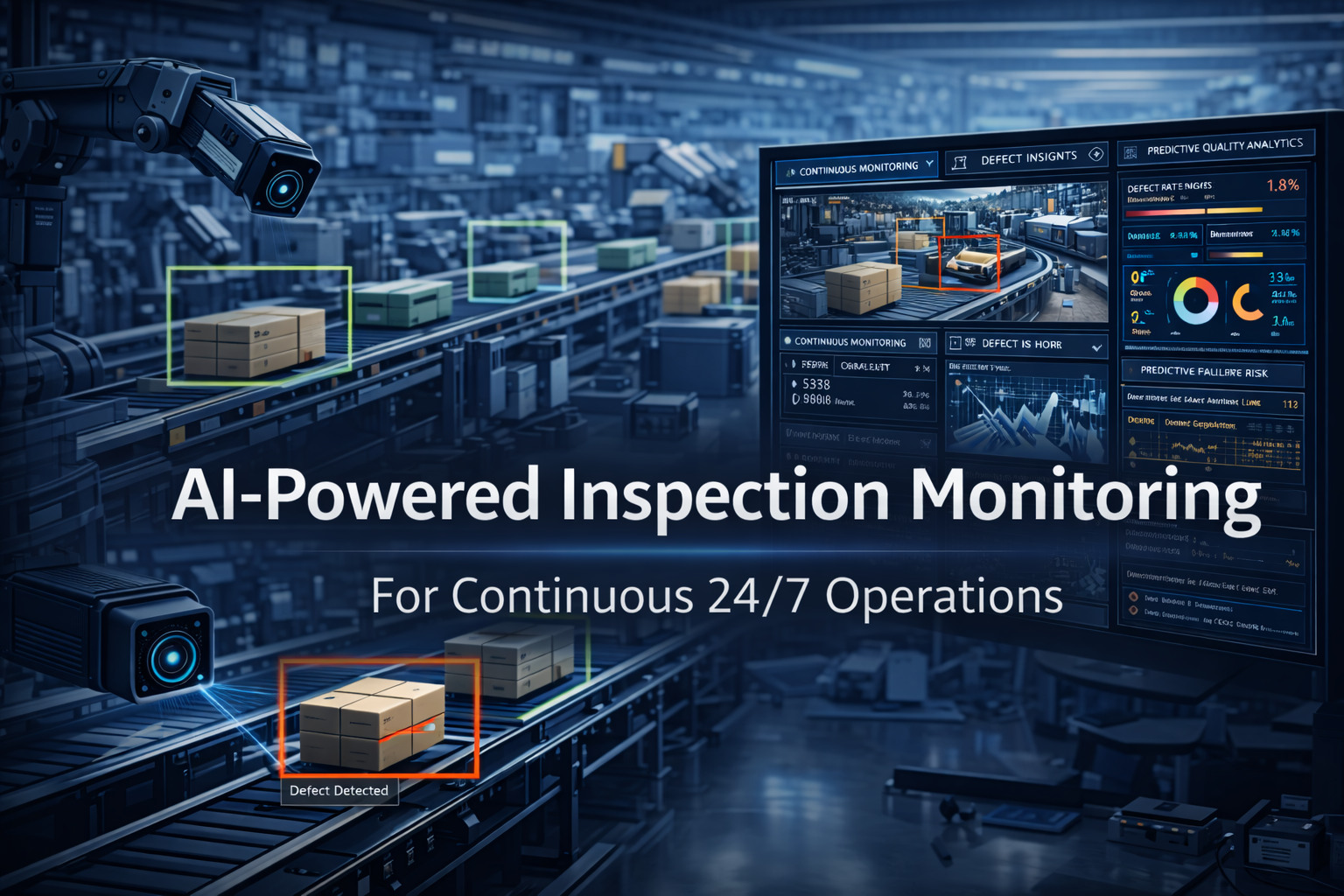
AI-Powered Inspection Monitoring for Continuous Operations: What Actually Works on the Ground
Anyone involved in a fast-moving business knows this: the work never stops, and problems rarely announce themselves politely. The production lines never stop, the machines never stop, and little problems tend to become costly when overlooked.
Teams are expected to identify those problems during inspection. And in a real sense, it is usually lagging.
A slower world was developed through manual inspections, periodic audits and conventional monitoring systems. The operations of today are quicker, longer and tighter than ever before. That is why AI-powered inspection monitoring is not something that companies are trying; it is something that companies have quietly been depending on.
Not because it is a fine thing to say. But because it works.
The Real Problem With Inspection in 24/7 Operations
There is not much room to go wrong with continuous operations. Be it manufacturing, energy, logistics or infrastructure, things will be on the go all day, all day. Pause to see what is going on is not always practical.
Human eyes are limited: people do their best.
- Concentration decreases in shifta long or repetitive.
- Inspections are not continuous.
- Small flaws are not hard to detect.
- When something is flagged, it has usually made an impression.
Most teams know this. They simply have not always had a better choice.
That is when AI-powered inspection monitoring begins to make sense, not as an alternative to human beings, but as the means to fill in the blank that people simply cannot.
What AI-Powered Inspection Monitoring Looks Like in Practice
In basic terms, AI-powered inspection monitoring involves cameras and sensors to keep an eye on the processes, and AI models examine what they detect in real-time. A system searches uncharacteristic defects, anomalies or variations that are not typical.
The significant aspect is that AI is not bored, stressed or fatigued.
Neither is it dependent on one rule or threshold. With time it gets to know what normal is like in your operation. It implies that it is able to detect minute changes that may not be alarming in themselves, but often indicate larger problems in the future.
This translates into reduced surprises and reduced firefighting at late hours in the case of floor teams.
Why AI-Driven Inspection Monitoring better suits the continuous operation.
Continuous processes require being awake all the time. That’s hard to achieve with rotating shifts and manual checks, no matter how skilled your people are.
Inspection That Doesn’t Switch Off
With AI in place, inspection becomes continuous by default. Every product, every cycle, every critical asset can be observed without interruption.
This is what makes true 24/7 monitoring inspection possible. Not spot checks. Not end-of-shift reviews. Actual, uninterrupted visibility.
For industries where even a short lapse can lead to quality issues or safety risks, that kind of coverage matters more than most people realize.
Catching Problems Earlier When They’re Easier to Fix
One of the biggest advantages teams notice early on is speed. AI systems don’t wait for a report or a review meeting. When something looks wrong, they flag it immediately.
That early signal often makes the difference between a small adjustment and a major disruption.
Quality Control Without Slowing Things Down
Conventional quality control can seem like a compromise. Either you reduce production speed to check the product more rigorously, or you are willing to risk that some defects will get past.
AI-powered inspection monitoring changes that dynamic.
By embedding inspection directly into live operations, quality checks happen in the background. There’s no need to pause production or pull large samples aside. Everything is checked on its way.
Gradually, the data collected during inspection is processed in predictive quality analytics, allowing the teams to know not only how something went wrong but why and when it is likely to occur.
It is the understanding that enables teams to avoid flaws rather than addressing them continuously.
Scaling 24/7 Monitoring Inspection Without Adding Complexity
As operations grow, inspection challenges grow with them. More lines, more equipment, more locations. Scaling manual inspection across all of that usually means higher costs and more inconsistency.
AI scales differently.
Once trained, inspection models apply the same standards everywhere. They don’t interpret things differently depending on who’s on shift. They don’t skip steps under pressure. With 24/7 monitoring inspection, quality expectations stay consistent day and night, site to site.
Remote visibility is yet another advantage that is easily overlooked. Inspection information can be centrally inspected, distributed through teams, and utilised to support quicker decisions without necessarily being on-site on the floor.
Why Predictive Quality Analytics Is Where the Real Value Shows Up
Spotting defects in real time is useful. But the longer-term value of AI inspection comes from what happens after.
As AI systems collect data, they begin to reveal patterns that aren’t obvious day to day. Predictive quality analytics turns that data into foresight.
Teams start seeing things like:
- Quality drifting under certain operating conditions
- Equipment issues that appear before failures occur
- Process steps that consistently introduce variation
This knowledge can assist teams to take action sooner, plan maintenance better, and prevent recurrent problems. In the long run, inspection does not entail fault detection but rather entails refining the system.
Building AI-Powered Inspection Monitoring into Practice
One concern teams often have is disruption. The good news is that AI-powered inspection monitoring doesn’t require ripping out existing systems.
Most solutions integrate with current cameras, sensors, and production platforms. Many organisations start small, one process, one line, one use case and expand once they see results.
No less important, AI is most effective when used alongside humans. AI will free up time that can be used to investigate and improve and make decisions where human judgment truly excels by dealing with repetitive inspection tasks.
Why More Teams Are Quietly Making the Switch
Organizations that adopt AI-powered inspection monitoring rarely do it for hype. They do it because it reduces stress on operations.
Common results include:
- Fewer defects reaching customers
- Less rework and scrap
- Earlier warnings before failures
- Better use of skilled personnel
When combined with 24/7 monitoring inspection and predictive quality analytics, inspection stops being a bottleneck and starts becoming a source of confidence.
Inspection That Matches the Pace of Modern Operations
Businesses are not slowing down. Demands regarding quality, safety, and efficiency are becoming increasingly challenging.
In that reality, inspection has to keep up. AI-powered inspection monitoring offers a practical way to do exactly that by providing constant visibility, meaningful insights, and faster response when it counts.
Not as a futuristic idea. But as a tool that fits how operations actually work.
Wish to See AI Inspection in Action?
VisionBot assists teams in overcoming the manual checks and creating efficient and consistent inspection systems utilizing AI.
Explore real-world AI-powered inspection monitoring for continuous operations at https://visionbot.com/