
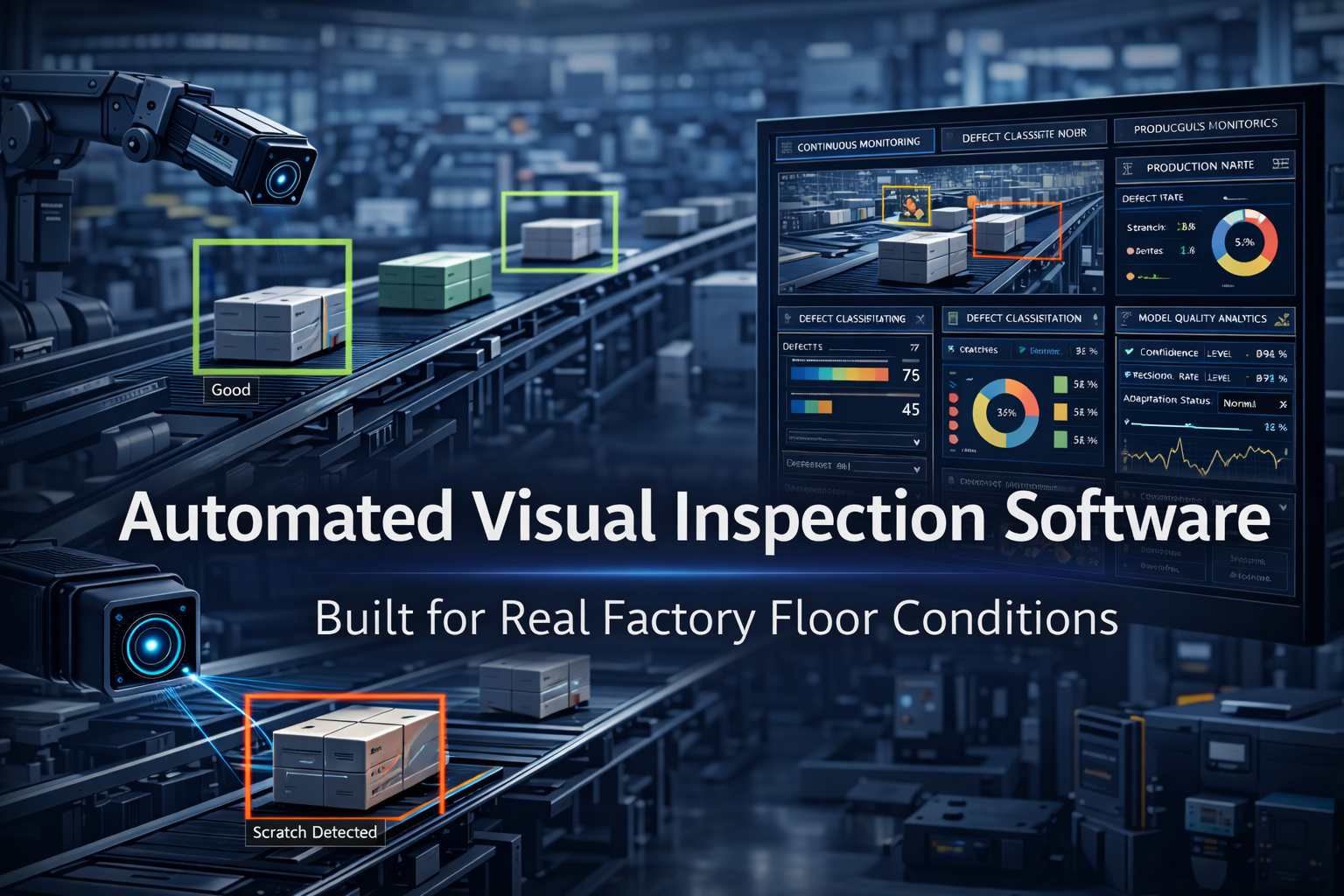
Automated Visual Inspection Software: What It Really Needs to Handle on the Factory Floor
Every person who has ever been on a real production line knows one thing: the real manufacturing never appears to be a demo video.
Lighting changes mid-shift. Parts arrive slightly different from the previous batch. Machines vibrate. Operators adjust things. And yet, quality expectations remain brutally high. That’s exactly why Automated visual inspection software has moved from being a “nice-to-have” to something manufacturers genuinely depend on.
But here’s the catch: inspection software that works in a controlled environment often struggles once it hits real production. The gap between “proof of concept” and “production-ready” is where many systems fail.
So what does Automated visual inspection software actually need to handle when it’s deployed on a live factory floor? Let’s talk about the realities, no buzzwords, no lab conditions.
Production Is Messy and Software Has to Deal With That
Ideally, inspection is easy: just take a photograph, match it with a good one, mark defects. As a matter of fact, production is full of tiny inconsistencies, which are not defects at all.
A slightly different surface texture. Minor color variation from a supplier change. Shadows caused by overhead lighting. These things happen daily.
Good Automated visual inspection software understands that perfection isn’t the goal consistency is. It must be able to tell the difference between normal variation and an actual quality issue without forcing constant re-tuning by engineers.
If the system needs daily babysitting, it won’t survive long in production.
Speed Matters More Than Most People Admit
On a live line, inspection can’t slow things down. Period.
Ideally, inspection is easy: just take a photograph, match it with a good one, mark defects. As a matter of fact, production is full of tiny inconsistencies, which are not defects at all. If inspection introduces latency, it doesn’t matter how accurate it is; production will reject it.
This is where Automated visual inspection software proves whether it’s built for the real world or just for presentations. It must process images in real time, integrate with line controls, and trigger pass/fail actions without hesitation.
Manufacturing doesn’t wait for algorithms to “think.”
automated quality inspection (AQI) Is No Longer Just an End-of-Line Job
Many factories start their inspection journey at the end of the line. That’s understandable, it’s the last chance to catch defects before shipping.
But mature manufacturers quickly realise that relying only on final inspection is expensive. Scrap has already been created. Time has already been wasted.
This is why automated quality inspection (AQI) is becoming more popular in the production process. Incoming materials, assembly steps, component placement, inspection happens everywhere now.
For this to work, inspection software must adapt to different contexts. A defect during assembly looks nothing like a defect on a finished product. The system has to understand where it’s being used and why.
Detection Alone Isn’t Enough: defect classification vs detection
This is one of the biggest gaps in many inspection deployments.
Finding something wrong is useful, but only to a point. Knowing what kind of defect it is changes everything. That’s where defect classification vs detection becomes critical.
In production, different defects lead to different actions:
- Some require stopping the line
- Some trigger rework
- Others point to upstream process issues
If Automated visual inspection software only flags “fail” without context, quality teams are left guessing. When it can classify defects, scratches vs dents, alignment vs missing components, it becomes a tool for improvement, not just rejection.
The Data Problem Nobody Talks About
Here’s an uncomfortable truth: most factories don’t have massive defect datasets.
And that’s actually a good thing. It means quality is already high.
But it creates a challenge for AI. There may be thousands of images of good parts and only a handful of defect examples. Some defect types might appear once a month, or once a year.
Production-ready Automated visual inspection software has to function under these constraints. It should be able to learn with limited data, evolve with the emergence of novel defect types and be improved over time without a massive labeling process.
Perfect dataset-based systems are often fragile when first exposed to real manufacturing.
Product Changes Happen, Inspection Must Keep Up
Anyone involved in manufacturing knows how often products change.
A new revision. A new supplier. A packaging update. A variant for a specific customer. These changes are normal, but they can break fragile inspection setups.
That’s why flexibility is non-negotiable for Automated visual inspection software. Updating inspection models should be fast and manageable, not a weeks-long project involving data scientists and line downtime.
The easier it is to adapt inspection to product changes, the more likely teams are to actually use it long term.
Industrial Reliability Is Not Optional
Factory environments are harsh. Cameras get bumped. Lenses get dirty. Networks drop. Hardware ages.
Inspection software must expect this.
In production, Automated visual inspection software needs built-in monitoring and fail-safes. It should alert teams when image quality degrades, when accuracy drops, or when something changes that could affect inspection results.
Silent failure is the worst-case scenario, because defective products keep moving while everyone assumes quality is under control.
Why Explainability Builds Trust on the Line
Let’s be honest: operators and quality engineers don’t blindly trust software.
If a system flags a defect, people want to know why. This is where defect classification vs detection shows its value again. Clear explanations, visual indicators, defect labels, and confidence levels—help teams trust decisions rather than fight them.
When inspection software feels like a black box, adoption suffers. When it feels like a helpful second set of eyes, people rely on it.
automated quality inspection (AQI) Must Fit Into Existing Systems
No factory wants another isolated system.
In order to work, automated quality inspection (AQI) should be seamlessly integrated with what already exists PLCs, MES, ERP systems, and reporting tools. Inspection data can only be useful when it is fed back into production decisions.
With inspection interlinked manufacturers have a chance to trace defects, find patterns, and make improvements at the top rather than responding to them at the bottom.
Scaling Beyond One Line Is the Real Test
Many inspection projects work well on a single line. Fewer succeed when scaled.
Enterprise-ready Automated visual inspection software must support multiple lines, plants, and locations while maintaining consistency. Centralized model management, performance monitoring, and version control become essential at scale.
If scaling feels harder than starting from scratch, something is wrong with the foundation.
Conclusion
The biggest mistake manufacturers make is assuming inspection software only needs to “see” defects. In reality, it needs to understand production.
True Automated visual inspection software is fast, adaptable, explainable, and resilient. It works with imperfect data, changing products, and real factory conditions without becoming a burden on the people who run the line.
That’s what separates successful inspection deployments from those that quietly get turned off after a few months.
Take the Next Step Toward Smarter Inspection
VisionBot delivers production-ready Automated visual inspection software designed for real manufacturing environments, not lab conditions.
Explore how it works at https://visionbot.com/