
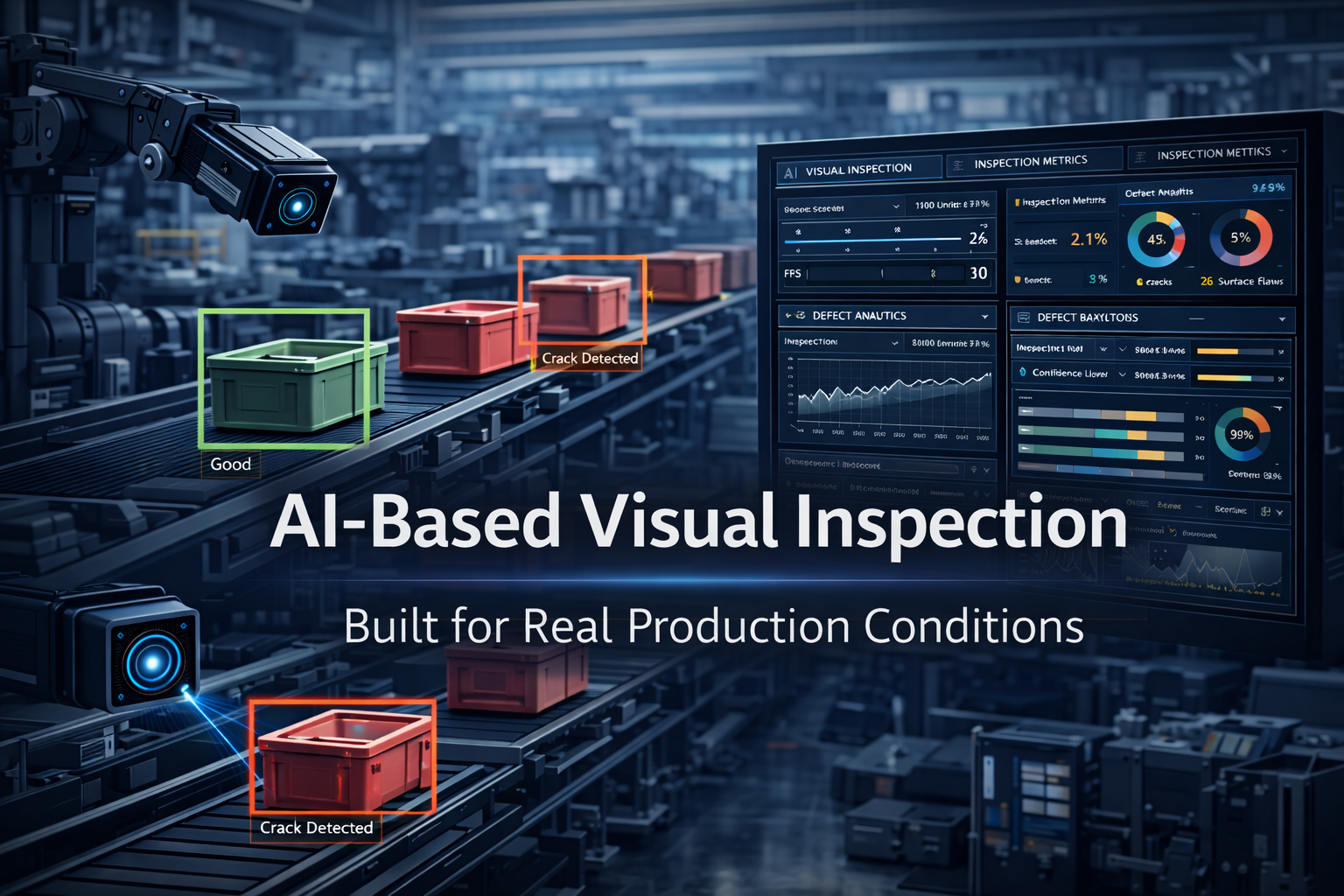
AI-Based Visual Inspection Under Real Production
Every person who has ever worked on a factory floor understands this fact: production does not always behave in the same way as a demo.
Nevertheless, the realities of AI-based visual inspection continue to be discussed in terms of ideally lit samples, immobile test rigs, and controlled environments that just do not occur when the system is stuck onto a live line. The difference between a successful demonstration and a system that can withstand the stress of real production is where most projects falter or are silently abandoned.
This article isn’t about the promise of AI vision. That part is already well understood. Instead, it’s about what happens when AI-based visual inspection meets the realities of running equipment at full speed, under tight margins, with zero tolerance for downtime.
What “Real Production” Actually Means
In theory, visual inspection sounds straightforward: capture an image, analyse it, and make a decision. In practice, production environments are chaotic.
Lighting changes during shifts. Equipment vibrates. Operators adjust settings. Materials vary slightly from batch to batch. Even a minor upstream change can ripple into your inspection system and quietly erode performance.
This is where many AI-based visual inspection initiatives lose momentum. Models trained on clean datasets suddenly face glare, dust, reflections, or subtle product deformation. The issue isn’t that AI doesn’t work; it’s that real production never stays still.
When AI-Based Visual Inspection Meets Line Speed Reality
Where theory meets reality is throughput pressure.
There is one thing that production managers are concerned about, and that is the continuation of the line. That’s why line speed vs FPS inspection is one of the most important and most misunderstood design considerations.
A vision system may perform flawlessly at a comfortable frame rate during testing. But once the line ramps up, inspection windows shrink. Decision-making has to be quicker, and even the slightest delay turns out to be a bottleneck. If your inspection can’t keep pace, accuracy becomes irrelevant.
At the same time, pushing frame rates higher often means trade-offs: reduced resolution, compressed models, or more expensive hardware. Balancing line speed vs FPS inspection isn’t about chasing specs, it’s about aligning inspection performance with production reality.
Accuracy Isn’t the Whole Story
There’s a quiet lesson learned by teams that have deployed multiple inspection systems: the most accurate model on paper is rarely the most useful one in production.
False rejects frustrate operators. Missed defects upset customers. But unpredictable behavior is what kills trust. A system that is a little less precise but consistently performs is likely to produce greater value than one that strives towards perfection.
This is why effective AI-based visual inspection implementations are concerned with stability, confidence scores, and explainability, rather than raw detection rates. Operators must know why something has been flagged, not that it has been flagged.
Latency, Edge Deployment, and Reality on the Shop Floor
Most production decisions can’t wait for cloud round-trips. Reject mechanisms, robotic actions, and alarms all depend on immediate feedback. That’s where real-time inference constraints become unavoidable.
Edge deployment solves latency problems but introduces new ones. Compute is limited. Thermal conditions are harsh. Hardware upgrades aren’t trivial. Models must be optimized carefully to run reliably day after day.
Ignoring real-time inference constraints early in the design phase often leads to painful rework later sometimes after the system is already live.
The Data Problem No One Likes to Talk About
Training data is another uncomfortable reality. Defects are rare by nature, which makes them hard to capture. Labels may be inconsistent. And production conditions change faster than most datasets are updated.
In real factories, AI-based visual inspection must be treated as a living system. That means:
- Retraining without stopping production
- Monitoring performance drift
- Incorporating operator feedback
- Adapting to new product variants
Teams that plan for continuous improvement tend to succeed. Those that treat deployment as the finish line usually don’t.
Integration Is Where Projects Slow Down
Vision systems don’t operate in isolation. They need to connect with PLCs, robots, HMIs, and MES platforms that may be years or decades old.
This is not a glamorous challenge of integration but a critical one. Without reliable signaling, deterministic timing, and clear diagnostics, even the best AI-based visual inspection solution becomes fragile.
In many cases, integration complexity, not model performance, is what defines long-term success.
Human Trust Still Matters
It is handled by operators, technicians, and quality engineers on a daily basis. Unless they believe it, they will get around it.
Clear visual feedback, adjustable thresholds, and straightforward review tools are a long way. Adoption becomes dramatically better when people feel that they are included and not overridden.
Ideally, AI-assisted visual inspection is a second pair of eyes that is consistent, exhaustive, and helpful, but is not an opaque black box.
Scaling Beyond a Single Line
Many inspection projects succeed on one line and stall when it’s time to scale. Different lighting, speeds, and operators. Then everything is different.
Scalable systems are built with variation in consideration. They embrace local flexibility and centralized control. They enable adaptation of models without having to start afresh.
Devoid of such an attitude, firms find themselves holding dozens of independent inspection systems that are both costly and hard to enhance.
Measuring ROI the Honest Way
ROI isn’t just about defect counts. It’s about stability, labor savings, reduced rework, faster problem diagnosis, and fewer customer complaints.
Next to actual constraints, AI-based visual inspection silently turns into one of the most useful instruments on the floor, regardless of being flashy or not, because it works.
Conclusion
The real challenge with AI-based visual inspection isn’t building models it’s deploying systems that survive production pressure.
Factories don’t pause for retraining. Lines don’t slow down for tuning. The systems that succeed are the ones designed for imperfection from day one.
Build Inspection Systems That Actually Work in Production
VisionBot helps manufacturers deploy AI-based visual inspection designed for real-world constraints, not lab conditions.
Explore practical, scalable vision solutions at https://visionbot.com/