
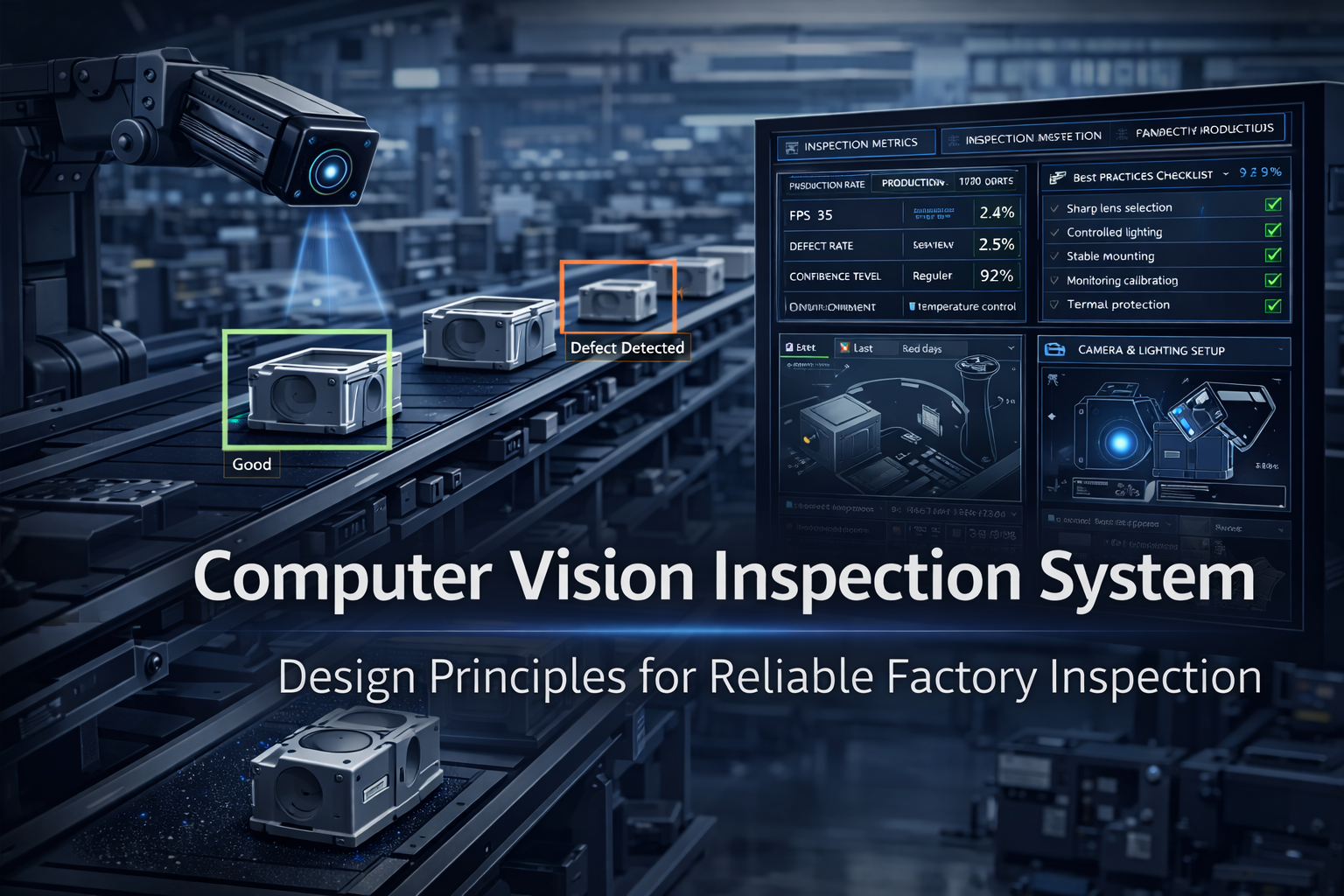
Design Principles Behind a Reliable Computer vision inspection system
Walk into any modern factory today and you’ll see automation everywhere, but quality inspection is still where many production lines struggle. The faster the speeds, the narrower the margins, the more dangerous it is to use nothing other than human eyes, which is inconsistent and costly. This is precisely why an increasing number of manufacturers are resorting to computer vision inspection system to secure product quality and production efficiency.
With that said, not all vision systems provide trustworthy results. In practical industrial applications where there is vibration, lighting variations, dust, and temperature variations, vision systems either work continuously or break down quickly. The distinction often reduces to design options at the outset.
This article breaks down the practical design principles behind building a Computer vision inspection system that works reliably on the factory floor, not just in a demo.
Why a Computer vision inspection system needs thoughtful design
At its core, a Computer vision inspection system captures images, analyzes them, and makes decisions, pass or fail, good or defective, correct or incorrect. Sounds simple on paper. In practice, it’s anything but.
Parts don’t always arrive perfectly aligned. Surfaces reflect light in unpredictable ways. Small changes in ambient conditions can throw off results. A well-designed system accounts for these realities instead of assuming ideal conditions.
That’s where experience-driven design and industrial imaging best practices really start to matter.
Start with clear inspection goals
One of the most common mistakes in vision projects is starting with hardware before defining the inspection problem clearly enough.
Before selecting cameras or software, it’s worth asking:
- What specific defect or feature actually matters?
- How small is it?
- How fast does the line move?
- What happens after the system flags a failure?
Clear answers prevent overengineering and keep costs under control. More importantly, they ensure the Computer vision inspection system is designed to solve the right problem, not just capture pretty images.
Optics matter more than most people think: lens selection for inspection
If there’s one lesson seasoned vision engineers repeat, it’s this: you can’t fix bad optics in software.
Smart lens selection for inspection determines whether defects are even visible in the first place. Image quality is affected by field of view, working distance, depth of field and distortion way before algorithms come into play.
According to the industrial imaging best practices, professional designers consider the following:
- Sharpness across the entire image
- Minimal distortion for measurement tasks
- Lenses built for industrial environments, not consumer use
Selecting the correct lens at the beginning will save hundreds of hours in troubleshooting time.
Lighting: the quiet deal-breaker
Lighting is never glamorous, and in most cases, it is the determining factor in success or failure.
Fluctuating lighting is the cause of fluctuating results in plain words. A reliable system uses controlled illumination to make important features stand out clearly, every single time.
Whether it’s backlighting for silhouette detection or dark-field lighting for surface defects, good lighting design follows proven industrial imaging best practices and is tightly matched to the inspection goal.
In many real-world projects, improving lighting delivers better results than changing cameras or algorithms.
Choosing the right camera and sensor
Cameras are often the focus of attention and rightfully so, although resolution is not necessarily the best. The trick is in associating the sensor to the task:
- Enough resolution to detect the smallest critical defect
- Frame rates that keep up with production
- Dynamic range that handles contrast variations
A balanced approach keeps the Computer vision inspection system efficient, reliable, and cost-effective.
Balanced methodology maintains the Computer vision inspection system efficient, reliable and cost-effective.
Algorithms must not be delicate.
Algorithms are where decisions are made, but reliability comes from restraint.
Systems that work only under “perfect” conditions don’t survive on the shop floor. Whether using traditional rule-based logic or modern machine learning, algorithms must tolerate normal variation without constant tuning.
The goal is consistency, not cleverness. A Computer vision inspection system that flags defects accurately day after day is far more valuable than one that looks impressive during setup but struggles in production.
Mechanical stability is part of vision design
The optics and software are the best, but any misalignment, vibration, or inconsistent part placement can spoil it.
Industrial imaging best practices include solid mounting, repeatability of fixturing, and mechanical alignment. When mechanical and vision design work together, system reliability improves dramatically.
Design for real factory conditions
Factories aren’t clean labs. Oil mist, dust, heat, and electrical noise are all part of the environment.
A dependable Computer vision inspection system is designed with:
- Protective enclosures
- Stable power and communication
- Thermal management for long-term operation
Ignoring environmental realities is a shortcut to downtime.
Calibration keeps systems honest
Even the best systems drift over time. Lenses shift, lighting ages, and mechanical components wear.
Frequent calibration will mean that inspection results are accurate and repeatable. This is particularly critical when measurement accuracy is determined by the correct choice of lens selection for inspection and stable optics.
Systems that are easy to calibrate are easier to maintain, and far more likely to deliver long-term value.
Think beyond today’s inspection
Production lines change. New products arrive. Requirements evolve.
Scalable systems involve modular hardware and flexible software because the Computer vision inspection system can be adopted without having to begin with a clean sheet. Growth planning is a time, money and frustration-saving step.
Final thoughts
They are the product of careful design decisions that consider optics, lighting, mechanics, software, and the facts of industrial settings.
Through adherence to industrial imaging best practices, making wise choices about the lens selection to use in inspection and designing to be robust, a Computer vision inspection system can be a consistent component of production, rather than a continuous rework generator.
Looking to implement vision inspection with confidence?
VisionBot helps manufacturers design and deploy inspection systems that work reliably in real production environments.
Learn more at https://visionbot.com/ and see how smarter vision can strengthen your quality process.