
Why Surveillance Infrastructure Is Becoming an IT Problem, Not a Security Problem
For years, surveillance systems were viewed as a responsibility of the security department. Cameras were installed to monitor entrances, prevent theft, investigate incidents, and ensure workplace safety. Once deployed, they often remained isolated from the broader technology ecosystem, managed independently by security teams with minimal involvement from IT.
That model is rapidly changing.
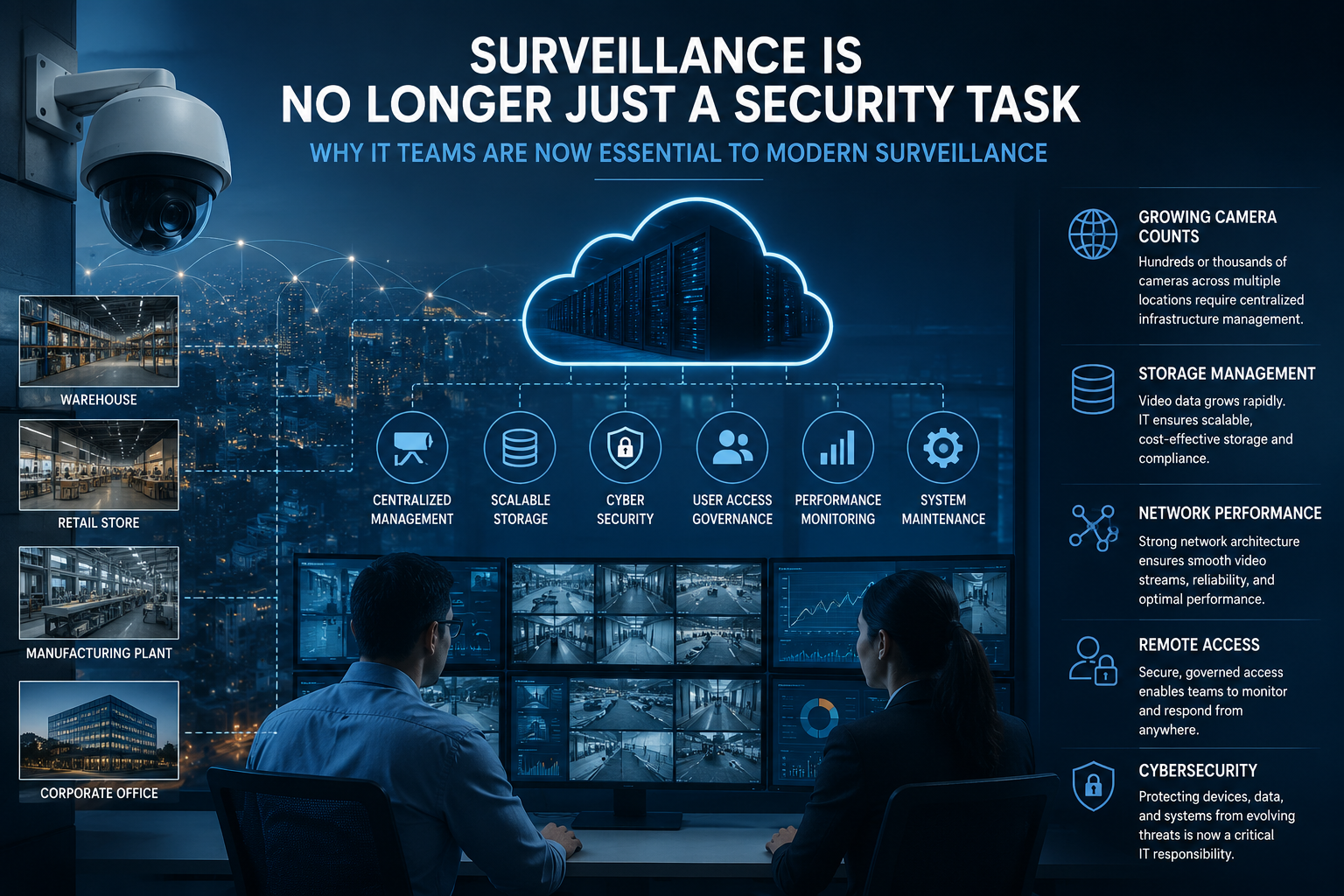
As organizations expand across multiple locations and deploy hundreds or even thousands of cameras, surveillance infrastructure has evolved into a complex digital ecosystem. Today, managing video data is no longer just about monitoring footage, it involves storage planning, network performance, cybersecurity, user access, cloud integration, and centralized administration. In many organizations, surveillance has become as much an IT responsibility as it is a security function.
This shift is prompting businesses to rethink who owns surveillance infrastructure and how it should be managed. Modern Cloud NVR platforms are leading this transformation by enabling IT and Security teams to collaborate through a centralized, scalable architecture.
The Evolution of Surveillance Systems
Traditional surveillance deployments were relatively straightforward. A facility would install a handful of cameras connected to a local Network Video Recorder (NVR). Security personnel could review footage when incidents occurred, and maintenance requirements were limited to occasional hardware upgrades or storage replacement.
Today’s enterprise environments are dramatically different.
Organizations now operate across multiple cities, countries, warehouses, retail outlets, manufacturing plants, and corporate offices. Each location may contain dozens or even hundreds of IP cameras generating continuous high-definition video streams.
This exponential growth has transformed surveillance into a large-scale technology infrastructure that requires careful planning and ongoing management.
Growing Camera Counts Are Creating Infrastructure Challenges
The increasing number of cameras is one of the biggest drivers behind this shift.
Businesses are deploying surveillance systems not only for physical security but also for operational intelligence, safety compliance, production monitoring, visitor analytics, quality assurance, and process optimization.
As camera counts grow, organizations must address several challenges:
- Continuous bandwidth utilization
- Device provisioning
- Firmware management
- Health monitoring
- Recording schedules
- Video retention policies
- Performance optimization
Managing hundreds of connected devices is no longer a manual task. It requires centralized infrastructure management similar to any enterprise IT environment.
Storage Management Has Become a Strategic Concern
Video data is among the largest forms of enterprise-generated content.
A single high-definition camera recording around the clock can produce substantial volumes of data over time. Multiply that by hundreds or thousands of cameras across multiple facilities, and storage quickly becomes a significant operational challenge.
Organizations must determine:
- How long should footage be retained?
- Which recordings require long-term archival?
- How should storage be allocated across sites?
- How can costs be controlled while maintaining compliance?
- How can data be recovered quickly during investigations?
Traditional on-premise NVR systems often require manual storage expansion, hardware replacement, and ongoing maintenance.
IT teams are increasingly expected to design scalable storage architectures that balance performance, cost, and compliance requirements.
Network Architecture Now Directly Impacts Surveillance Performance
Modern surveillance depends heavily on network infrastructure.
Every connected camera consumes bandwidth, transmits video streams, communicates with recording servers, and may even support AI-powered analytics running at the edge or in the cloud.
Poor network design can result in:
- Video latency
- Packet loss
- Interrupted recordings
- Reduced image quality
- Slow remote access
- Analytics failures
IT departments must carefully evaluate network capacity, segmentation strategies, Quality of Service (QoS), and connectivity across distributed locations to ensure reliable surveillance operations.
As surveillance systems become increasingly connected, network architecture becomes a critical component of overall system performance.
Remote Access Requires Strong Governance
Modern organizations expect authorized personnel to access surveillance systems from virtually anywhere.
Regional managers may need to monitor multiple facilities. Security teams often investigate incidents remotely. Operations managers rely on live video feeds to oversee production, logistics, or retail performance.
While remote accessibility improves efficiency, it also introduces governance challenges.
Organizations must establish clear policies around:
- User authentication
- Role-based permissions
- Multi-factor authentication
- Audit logging
- Access expiration
- Device authorization
Without proper governance, remote access can create unnecessary security risks.
IT teams play a vital role in implementing secure identity management practices while ensuring that surveillance remains easily accessible to authorized users.
Cybersecurity Is Now a Core Surveillance Requirement
IP cameras, NVRs, and video management systems are connected devices.
Like any endpoint on an enterprise network, they must be protected against cyber threats.
Common security concerns include:
- Weak default credentials
- Outdated firmware
- Unauthorized device access
- Malware attacks
- Ransomware targeting video infrastructure
- Data interception
- Network vulnerabilities
A compromised surveillance system can expose sensitive operational data and create significant business risks.
This is why surveillance infrastructure increasingly falls under enterprise cybersecurity strategies.
IT departments now routinely monitor surveillance devices alongside servers, workstations, cloud services, and other connected systems.
Multi-Site Administration Is Difficult with Legacy Systems
Many organizations continue to operate independent surveillance systems at each facility.
Each location may have:
- Separate NVR hardware
- Different storage configurations
- Independent user databases
- Unique software versions
- Local administrators
This fragmented approach creates unnecessary complexity.
Routine tasks such as software updates, user provisioning, troubleshooting, and health monitoring must often be repeated for every individual site.
As organizations expand, administrative overhead increases significantly.
Managing surveillance across dozens or hundreds of locations requires centralized visibility rather than isolated systems.
The Traditional Ownership Model Is No Longer Sustainable
Historically, surveillance purchasing decisions were driven almost entirely by physical security teams.
Today, successful deployments require expertise from multiple departments.
Security teams understand operational requirements, incident response, and compliance.
IT teams contribute expertise in:
- Network infrastructure
- Cloud architecture
- Identity management
- Storage optimization
- System scalability
- Cybersecurity
- Business continuity
Neither department can effectively manage enterprise surveillance in isolation.
The future lies in collaborative ownership where both teams contribute their respective strengths.
How Cloud NVR Changes the Ownership Model
Modern Cloud NVR platforms fundamentally change how surveillance infrastructure is managed.
Instead of relying on isolated recording hardware at every location, Cloud NVR centralizes management through a unified platform that supports both IT and Security teams.
This approach offers several advantages.
Centralized Device Management
Administrators can monitor camera health, recording status, storage usage, and system performance across multiple locations from a single dashboard.
This significantly reduces operational complexity.
Simplified Storage Management
Cloud-based architectures eliminate many of the storage limitations associated with traditional NVR systems.
Organizations can implement scalable storage policies without constantly expanding local hardware.
Unified User Administration
Role-based access controls allow organizations to manage permissions centrally.
Security personnel, plant managers, executives, and IT administrators can receive access appropriate to their responsibilities without maintaining separate accounts at every location.
Improved Cybersecurity
Centralized management enables faster software updates, consistent security policies, stronger authentication, and better audit capabilities.
IT teams gain greater visibility into surveillance infrastructure while reducing security gaps across distributed sites.
Remote Monitoring at Scale
Whether an organization operates five locations or five hundred, authorized users can securely monitor cameras, review recordings, and investigate incidents through a centralized interface.
This supports operational efficiency while maintaining governance standards.
Building a Future-Ready Surveillance Architecture
Organizations investing in surveillance today should think beyond cameras alone.
A modern surveillance architecture should support:
- Scalable infrastructure
- Cloud integration
- AI-powered analytics
- Centralized administration
- Secure remote access
- Flexible storage
- Multi-site visibility
- Cybersecurity best practices
These capabilities transform surveillance from a standalone security tool into an enterprise-wide digital platform.
As artificial intelligence continues to enhance video analytics, the underlying infrastructure becomes even more important. Reliable networks, secure storage, centralized management, and cloud scalability provide the foundation required for intelligent automation and operational insights.
How VisionBot Supports Modern Surveillance Infrastructure
As surveillance infrastructure becomes increasingly integrated with enterprise IT, organizations need platforms designed for both operational efficiency and long-term scalability.
VisionBot’s Cloud NVR architecture brings IT and Security teams together through a centralized platform that simplifies surveillance management across multiple locations. Instead of maintaining isolated systems at every site, organizations can monitor camera health, manage storage, control user access, and oversee recording performance from a single cloud-hosted dashboard.
The platform is designed to work with existing IP camera infrastructure while supporting centralized administration, secure remote access, scalable cloud storage, and multi-site visibility. This unified approach reduces operational complexity, strengthens governance, and provides the foundation for advanced Visual AI capabilities as business needs evolve.
By combining Cloud NVR with AI-powered video analytics, VisionBot enables organizations to move beyond traditional surveillance and build an intelligent, enterprise-ready monitoring ecosystem.
Conclusion
Surveillance is no longer just about recording video—it has become a critical part of an organization’s digital infrastructure.
Growing camera deployments, increasing storage demands, complex network requirements, cybersecurity risks, and multi-site operations have shifted surveillance management beyond the boundaries of traditional security teams.
The organizations best prepared for the future recognize that surveillance is now a shared responsibility between IT and Security. By adopting centralized Cloud NVR platforms, they can simplify administration, improve governance, strengthen cybersecurity, and create a scalable foundation for intelligent video operations.
As enterprise surveillance continues to evolve, the question is no longer whether IT should be involved, it is how effectively IT and Security can work together to build a resilient, secure, and future-ready surveillance ecosystem.