
From One Store to One Hundred Locations: Designing a Scalable Visual AI Strategy
For many enterprises, adopting Visual AI begins with a single question: Can AI solve a specific operational problem at one location? Whether it’s reducing safety violations in a manufacturing plant, monitoring queue congestion in a retail store, or identifying unauthorized access in a warehouse, the first deployment is often a proof of concept.
However, the real challenge begins after the pilot succeeds.
How do you extend that success from one site to ten, fifty, or even a hundred locations without creating inconsistent processes, disconnected data, or a management nightmare?
Scaling Visual AI is not simply about installing more cameras or deploying additional AI models. It requires a carefully designed enterprise strategy that standardizes operations, centralizes insights, and ensures every location follows the same intelligence framework while accommodating site-specific requirements.
This article explores how organizations can systematically scale Visual AI across multiple locations and how VisionBot’s cloud-hosted platform and multi-site architecture make enterprise-wide deployments efficient, manageable, and future-ready.
Why Scaling Visual AI Is Different from Installing More Cameras
Traditional CCTV expansion is relatively straightforward. Add more cameras, connect them to a network, and increase storage capacity.
Visual AI is fundamentally different.
Every camera becomes an intelligent data source that generates operational insights, alerts, analytics, and business events. As the number of sites grows, so does the complexity of managing AI models, monitoring events, maintaining consistency, and ensuring that each location adheres to the organization’s operational standards.
Without a structured rollout strategy, enterprises often encounter challenges such as:
- Different locations using different event configurations
- Inconsistent alert thresholds
- Fragmented reporting systems
- Difficulty comparing operational performance across branches
- Increased maintenance effort for AI models
- Limited visibility into enterprise-wide operations
A scalable Visual AI strategy addresses these challenges from the very beginning rather than attempting to fix them after expansion.
Phase 1: Start with a Focused Pilot Deployment
Every successful enterprise rollout begins with a pilot project.
Instead of trying to automate every process simultaneously, organizations should identify one or two high-impact operational challenges that are measurable and repeatable.
For example:
- A retailer may focus on checkout queue monitoring.
- A warehouse may begin with forklift movement analysis.
- A manufacturing facility may prioritize PPE compliance.
- A logistics company may monitor loading dock activity.
- A corporate office may automate restricted-area access monitoring.
The objective of the pilot is not merely to prove that AI works but to validate measurable business outcomes. Key performance indicators might include reduced safety incidents, improved operational efficiency, lower response times, or decreased manual monitoring effort.
A well-executed pilot also establishes the foundation for enterprise-wide standards that will later be replicated across multiple locations.
Building a Camera Onboarding Framework
One of the biggest misconceptions about scaling Visual AI is that adding cameras is simply an IT task.
In reality, camera onboarding is a strategic process that directly impacts AI performance.
Before integrating cameras into the Visual AI platform, organizations should evaluate:
- Camera placement
- Viewing angles
- Lighting conditions
- Resolution quality
- Field of view
- Network connectivity
- Operational coverage
Existing CCTV infrastructure can often be integrated without replacing hardware, provided the cameras meet the necessary quality requirements.
By creating standardized onboarding guidelines, enterprises ensure that every new site delivers consistent AI performance regardless of geographical location.
Instead of configuring each camera differently, organizations can define reusable deployment templates based on operational areas such as entrances, loading zones, production lines, retail aisles, or warehouse corridors.
This significantly accelerates expansion as new locations can adopt proven configurations rather than starting from scratch.
Standardize Events, Not Just AI Models
Many organizations focus on deploying identical AI models across locations.
A more effective strategy is to standardize business events.
An object detection model may identify people, vehicles, forklifts, or equipment. However, different businesses derive value from the operational events created using those detections.
For example, “forklift detected” is simply an observation.
Meaningful business events include:
- Unauthorized forklift movement after operating hours
- Material left in loading zones beyond a specified time
- Safety gear violations in restricted production areas
- Queue congestion exceeding service-level thresholds
- Unauthorized entry into sensitive zones
- Emergency exits being blocked
- Vehicles parked in prohibited areas
These event definitions become enterprise-wide operational policies.
When every location follows identical event rules, management gains consistent visibility across all sites while maintaining compliance standards throughout the organization.
Centralized Cloud Monitoring Creates Enterprise Visibility
As organizations expand across cities, states, or countries, manually monitoring individual locations becomes impractical.
This is where centralized cloud monitoring transforms enterprise operations.
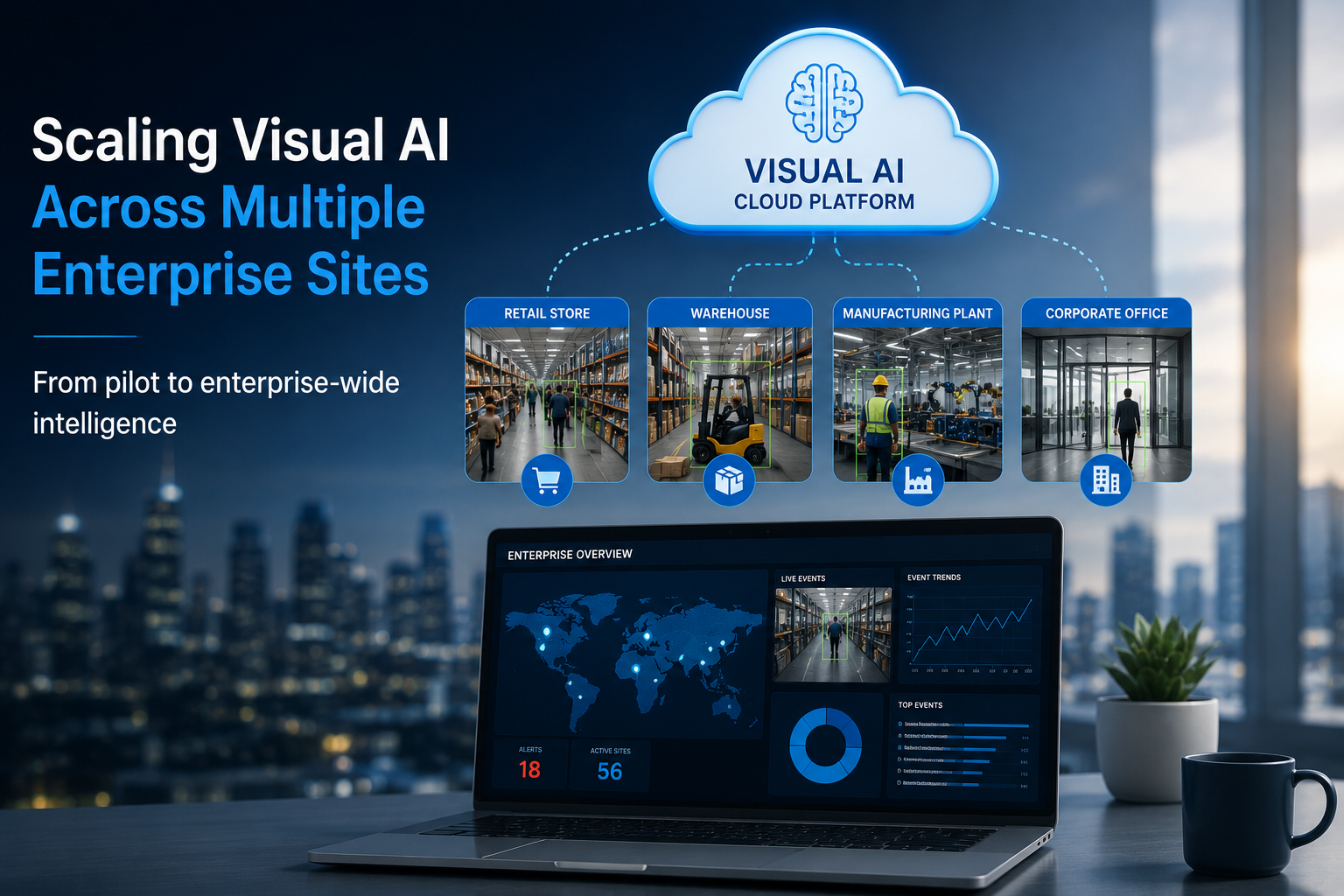
Rather than maintaining isolated systems at each site, organizations can monitor all AI-generated events from a single cloud-hosted dashboard.
Instead of opening separate interfaces for every branch, operations teams gain:
- Enterprise-wide visibility
- Live event feeds
- Real-time alerts
- Historical analytics
- Incident investigations
- Site comparisons
- Operational reporting
Managers no longer need to travel between locations to understand operational performance.
Regional teams can monitor dozens of facilities simultaneously while headquarters maintains complete visibility across the entire organization.
This centralized approach also reduces infrastructure complexity, simplifies maintenance, and ensures that updates are rolled out consistently.
Site-Wise Analytics Drive Better Decision-Making
As deployments grow, comparing operational performance across locations becomes increasingly valuable.
Site-wise analytics allow organizations to understand how individual branches perform against enterprise benchmarks.
For example, a retail chain might compare:
- Average queue waiting times
- Customer footfall
- Peak traffic periods
- Shelf replenishment delays
- Checkout efficiency
A manufacturing company may compare:
- PPE compliance rates
- Machine downtime
- Safety incidents
- Production bottlenecks
- Material handling efficiency
Similarly, a logistics company can evaluate:
- Dock utilization
- Vehicle turnaround times
- Loading delays
- Yard congestion
- Inventory movement
These insights enable leadership teams to identify high-performing locations, detect operational inconsistencies, and replicate best practices throughout the organization.
Instead of relying on intuition, expansion decisions become data-driven.
Multi-Site Architecture Simplifies Enterprise Growth
Scaling Visual AI should never require rebuilding the system for every new location.
A multi-site architecture is designed specifically to support continuous expansion while maintaining centralized control.
With this approach, every location functions independently for local operations while remaining connected to a unified enterprise platform.
This architecture offers several advantages:
- New locations can be added quickly.
- Existing AI workflows can be replicated.
- Central teams retain governance over configurations.
- Regional managers receive location-specific visibility.
- Enterprise dashboards aggregate insights across all facilities.
As businesses grow organically or through acquisitions, the Visual AI infrastructure grows alongside them without disrupting ongoing operations.
This flexibility is particularly valuable for organizations managing hundreds of geographically distributed facilities.
Scaling Across Regions Without Losing Consistency
Expansion often introduces regional differences.
Different facilities may have:
- Unique layouts
- Different operating hours
- Local compliance requirements
- Varying staffing levels
- Diverse environmental conditions
A scalable Visual AI strategy balances standardization with flexibility.
Core enterprise policies, such as safety compliance, restricted-area monitoring, and security protocols, remain consistent across every location.
At the same time, individual sites can customize event thresholds, operational schedules, or region-specific workflows without affecting the overall enterprise framework.
This layered approach ensures that organizations maintain governance while allowing local teams to adapt AI to operational realities.
Operational Governance Becomes More Important as AI Scales
As deployments expand, governance becomes just as important as technology.
Organizations should establish clear ownership for:
- AI model management
- Event rule updates
- Camera health monitoring
- Dashboard administration
- User access permissions
- Incident escalation
- Performance reporting
Without governance, AI systems can gradually become inconsistent across locations.
A centralized administration model ensures that every site follows the same operational standards while maintaining accountability for local execution.
Future-Proofing Enterprise AI Deployments
Technology continues to evolve rapidly.
New AI models, improved analytics, and emerging business requirements will inevitably require updates.
A scalable strategy anticipates this evolution.
Instead of designing systems around today’s requirements, organizations should build an architecture capable of supporting:
- Additional cameras
- New locations
- New business events
- Advanced analytics
- AI model upgrades
- Integration with enterprise software
- Cross-functional automation
This approach protects long-term investments while allowing organizations to continuously improve operational intelligence.
How VisionBot Enables Enterprise-Scale Visual AI
Scaling Visual AI requires more than accurate object detection. It demands a platform built for enterprise operations.
VisionBot’s cloud-hosted dashboard provides centralized visibility across multiple facilities, allowing organizations to monitor AI-generated events from a single interface rather than managing isolated systems at each site.
Its multi-site architecture supports onboarding new locations without redesigning the entire deployment, making expansion significantly faster and more consistent. Existing CCTV infrastructure can be integrated into the platform, while standardized event configurations ensure that every facility follows the same operational policies.
Instead of merely detecting objects, VisionBot enables organizations to define meaningful visual events, such as PPE violations, restricted-area access, loading zone congestion, or unauthorized equipment movement, and apply those rules consistently across every location.
With centralized monitoring, real-time alerts, historical reporting, and site-wise analytics, decision-makers gain a comprehensive view of operations across regions. This unified approach helps enterprises compare performance, identify trends, and make data-driven improvements while maintaining governance over every deployment.
Conclusion
The success of Visual AI is not determined by how well it performs at a single location. Its true value emerges when organizations can replicate that success across an entire enterprise.
Moving from one store to one hundred locations requires more than additional hardware, it requires a scalable strategy built on standardized event rules, structured camera onboarding, centralized cloud monitoring, site-wise analytics, and a flexible multi-site architecture.
Organizations that approach Visual AI as an enterprise transformation initiative rather than an isolated technology project are better positioned to improve operational consistency, strengthen compliance, and gain real-time visibility across every facility.
As businesses continue to expand, a systematic rollout strategy ensures that every new location becomes part of a unified intelligence network, turning distributed video data into centralized operational insight and enabling smarter decisions at enterprise scale.