
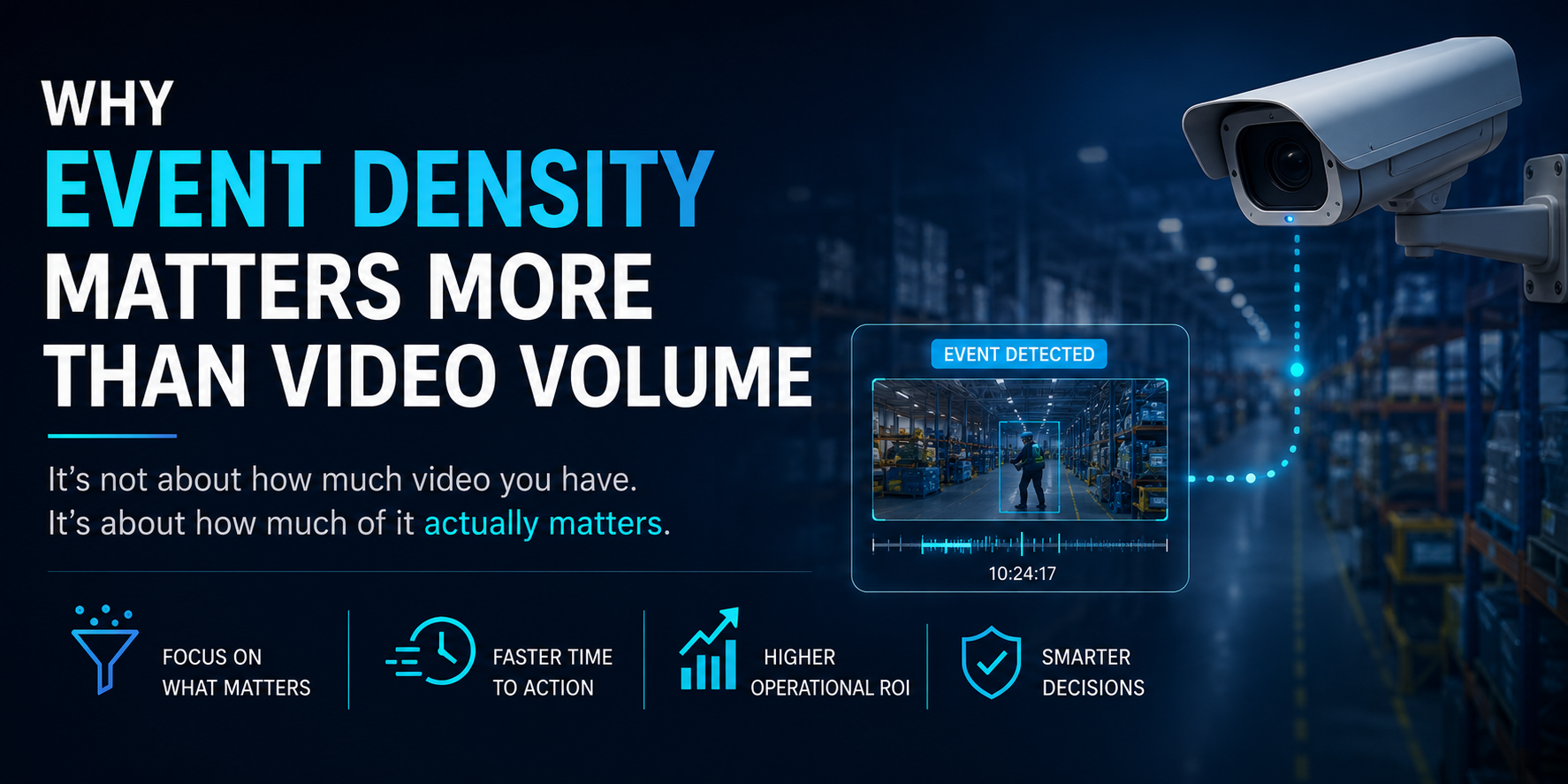
Event Density vs Video Duration: A Better Way to Measure ROI in Video Analytics
Most video analytics conversations start with numbers that feel logical—but don’t actually tell you much.
“How many cameras are we running?”
“How many hours of video are we processing daily?”
“What’s our total storage footprint?”
These metrics are easy to quantify, easy to present, and easy to scale.
But if you’ve spent time around real deployments—not demos, not pilots, but actual systems running across factories, warehouses, or retail environments—you’ll notice something quickly:
The amount of video you process has almost nothing to do with the value you get from it.
Two systems can process the same number of hours. One becomes central to operations. The other quietly turns into a storage burden nobody wants to touch.
So the question isn’t how much video you have.
It’s:
How much of that video actually matters?
The Comfort of Measuring Duration
There’s a reason teams default to measuring video in hours.
It comes from how surveillance systems were originally designed.
The goal was simple:
- capture everything
- store it reliably
- retrieve it when needed
In that world, duration was a proxy for coverage.
More hours meant:
- more visibility
- more accountability
- more “safety”
And since nothing was being analyzed in real time, this made sense.
Where This Model Breaks
The moment you introduce AI, the purpose of video changes.
You’re no longer trying to preserve reality.
You’re trying to extract signals from it.
And signals don’t occur continuously.
They occur in short, uneven bursts.
Think About Any Real Environment
Take a warehouse floor.
For most of the day:
- things move normally
- processes follow routine
- nothing unusual happens
Then, occasionally:
- a package is mishandled
- a safety protocol is violated
- a bottleneck forms
- something breaks
Those moments are where value lies.
Not in the hours of normal operation around them.
The Core Problem: Treating All Video Equally
Most systems still treat video as if every second has equal importance.
So they:
- record continuously
- process large volumes
- store everything
But only a tiny fraction of that data is ever:
- reviewed
- analyzed
- acted upon
The Result
- operators are overwhelmed
- storage grows endlessly
- insights remain buried
And ironically:
the more video you have, the harder it becomes to extract value from it
Introducing Event Density
To fix this, we need a different way of thinking.
Instead of measuring:
- how much video exists
We measure:
how much meaningful activity exists within that video
This is where the idea of event density comes in.
A Practical Definition
Event Density =
Number of meaningful, actionable events detected per unit of video time
Why This Changes Everything
Because it shifts focus from:
- volume → relevance
- accumulation → extraction
- storage → usability
A Ground-Level Example
Let’s compare two real-world style scenarios.
Deployment 1: High Volume, Low Insight
- 80 cameras
- 24/7 recording
- centralized storage
Processing:
- large amounts of footage
- minimal filtering
Outcome:
- incidents are found manually
- most footage is never reviewed
Event Density:
- very low
Deployment 2: Lower Volume, High Insight
- 40 cameras
- edge-based event detection
- filtered transmission
Processing:
- only meaningful events flagged
- structured storage
Outcome:
- operators review events, not footage
- patterns are identified quickly
Event Density:
- significantly higher
Which One Has Better ROI?
Not the one with more cameras.
Not the one with more footage.
The one with higher event density.
Why Event Density Is Closer to Real ROI
Because value in video analytics doesn’t come from seeing more.
It comes from:
- noticing what matters
- reducing time to awareness
- enabling action
Think in Terms of Time
In a low-density system:
- finding an event might take 15–20 minutes
In a high-density system:
- the event is already surfaced
That difference compounds daily.
A Simple Calculation
If:
- an operator saves 10 minutes per incident
- and handles 50 incidents per day
That’s:
- 500 minutes saved daily
Across teams and locations, that becomes:
- operational efficiency
- not just technological capability
The Hidden Enemy: False Positives
Now here’s where things get more nuanced.
Increasing event density isn’t just about detecting more events.
Because not all events are useful.
The Problem
If your system flags everything:
- event density increases artificially
- but usefulness decreases
Operators start ignoring alerts.
This Is Where Many Systems Fail
They optimize for:
- detection count
Instead of:
- detection quality
True Event Density vs Artificial Density
Let’s separate the two.
Artificial Event Density
- high number of detections
- low relevance
- high false positives
Result:
- alert fatigue
- reduced trust
True Event Density
- fewer but meaningful events
- high relevance
- actionable insights
Result:
- faster decisions
- higher system adoption
How System Design Shapes Event Density
Event density is not just about AI models.
It’s about the entire pipeline.
1. Input Quality (Where Most Problems Start)
If your video streams are:
- inconsistent
- jittery
- poorly synchronized
Then:
- detections become unreliable
- events get missed
This is why ingestion layers matter more than people think.
When input is stabilized:
- detection becomes consistent
- event capture improves
2. Edge Processing (Filtering Early)
If you send everything to the cloud:
- you carry noise forward
If you process at the edge:
- you filter early
- you reduce irrelevant data
This directly improves event density.
3. Event Structuring
Detection alone isn’t enough.
Events need to be:
- categorized
- time-indexed
- contextualized
Otherwise:
- they remain difficult to use
4. Storage Strategy
If storage is just raw footage:
- retrieval is slow
If storage is event-linked:
- retrieval becomes instant
What Happens When Event Density Is Ignored
This is where things break at scale.
Scenario: Growing Deployment
A system starts with:
- 10 cameras
Everything works.
Then it grows to:
- 100 cameras
Now:
- footage multiplies
- manual effort explodes
- insights don’t scale
The System Becomes:
- harder to use
- less trusted
- underutilized
The Operational Shift
When event density is optimized, the system changes behavior.
Before
- search-driven
- reactive
- manual
After
- event-driven
- proactive
- assisted
This Is the Real Transformation
Not:
- better storage
But:
better attention allocation
A Subtle but Important Insight
Video is not scarce.
Human attention is.
And most systems are designed around the wrong constraint.
Designing for Event Density
If you were to design a system from scratch with this in mind, you would:
Not Start With Cameras
You would start with:
- what events matter
Then Work Backwards
- what signals indicate those events
- where detection should happen
- how data should flow
Instead of:
“Where do we store video?”
You ask:
“How do we surface what matters?”
Why This Becomes a Competitive Advantage
Organizations that understand this:
- act faster
- detect patterns earlier
- reduce operational waste
Others:
- accumulate data
- but struggle to use it
Final Thought
For years, video systems were measured by:
- how much they could store
But storage is no longer the constraint.
Understanding is.
And understanding doesn’t come from more footage.
It comes from:
finding more meaning within less
Building High Event-Density Systems with VisionBot
If your current system feels heavy, slow, or underused, it’s often not a processing problem—it’s a signal problem.
VisionBot’s architecture is designed to improve event density across the pipeline:
- Streaming Gateway (S06) → stabilizes input so events aren’t missed
- Edge AI Servers (A16, M08, B04) → filter and detect events at the source
- Cloud NVR → stores event-linked video for fast retrieval
- Cloud Hosted Platform → aggregates and analyzes patterns across locations
The focus isn’t on processing more video.
It’s on making sure the video you process actually matters.