
From DVR to Cloud NVR: What Actually Changes in System Architecture and Cost?
Introduction: It’s Not Just an Upgrade, It’s a System Shift
Many teams think moving from DVR to Cloud NVR is a simple upgrade.
Better storage.
Remote access.
More flexibility.
But that’s a surface-level view.
In reality, this transition represents a fundamental shift in how surveillance systems are designed, operated, and scaled.
If you treat it like a hardware upgrade, you’ll miss the real impact.
If you understand it as an architectural change, you unlock entirely new capabilities.
What DVR Systems Were Designed For
DVR (Digital Video Recorder) systems were built for a different era.
Their design assumptions were:
- Cameras are analog
- Processing happens locally
- Storage is fixed and on-site
- Access is limited to physical locations
The system is tightly coupled:
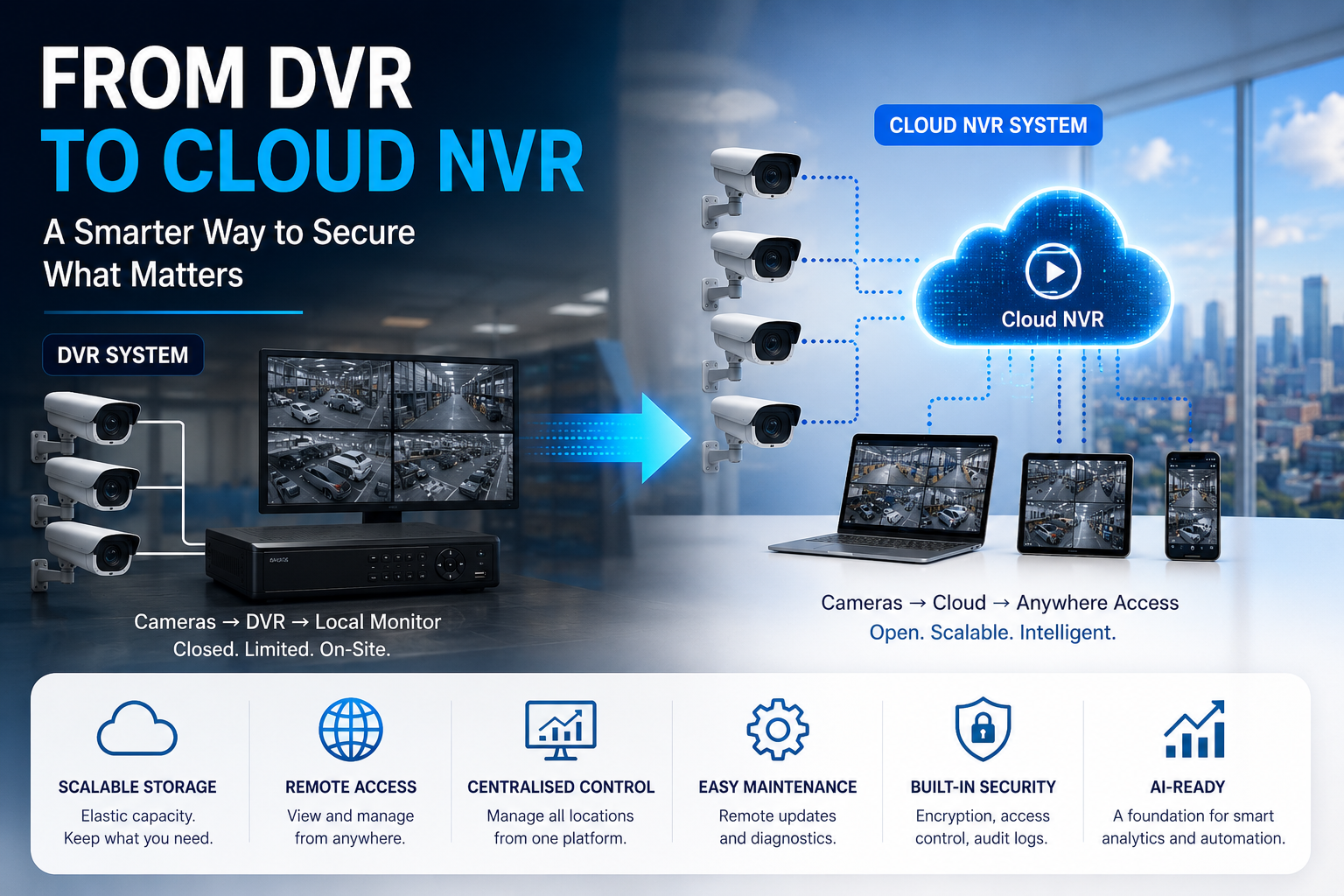
- Cameras → DVR → Local monitor
Everything happens within a closed loop.
This makes DVR systems:
- Simple
- Predictable
- Limited in scope
They work well for single-location setups, but struggle as complexity increases.
The Structural Limitations of DVR
As environments evolved, DVR systems started showing cracks.
Fixed Capacity
Storage is limited by the hardware installed on-site.
Physical Dependency
Access often requires being on location or using clunky remote setups.
Rigid Architecture
Adding new cameras or features requires hardware changes.
Limited Integration
DVR systems are not designed to integrate easily with modern analytics tools.
These limitations are not bugs. They are a result of how DVR systems were originally designed.
Enter Cloud NVR: A Different Design Philosophy
Cloud NVR is not just a recorder placed in the cloud.
It is a system built around:
- Networked cameras
- Distributed data flow
- Centralised management
- Scalable infrastructure
Instead of a closed loop, it operates as an open system.
Cameras send data over networks.
Storage and processing happen in flexible environments.
Access is no longer tied to a location.
Architectural Shift: From Closed Systems to Distributed Systems
The biggest change is architectural.
DVR Architecture
- Central device per site
- Direct camera connections
- Localised storage and processing
Cloud NVR Architecture
- Network-connected cameras
- Data transmitted over IP
- Centralised or distributed cloud storage
- Remote access layers
This changes how systems behave under load, how they scale, and how they are managed.
Data Flow Transformation
In DVR systems:
- Data flows inward to a single device
- It stays local unless manually extracted
In Cloud NVR systems:
- Data flows across networks
- It can be accessed, processed, and analysed remotely
This enables:
- Real-time remote monitoring
- Centralised analysis
- Integration with other systems
The system becomes part of a larger ecosystem rather than an isolated unit.
Storage: From Fixed Limits to Elastic Capacity
One of the most visible changes is storage.
DVR Storage
- Fixed hard drives
- Limited retention period
- Manual upgrades required
Cloud NVR Storage
- Scalable storage
- Adjustable retention policies
- No physical constraints per site
This removes one of the biggest operational headaches in traditional systems.
Access and Control: Breaking Location Barriers
DVR systems are location-bound.
Cloud NVR systems are access-driven.
You can:
- View footage from anywhere
- Manage multiple locations centrally
- Control settings without physical presence
This shift improves:
- Operational efficiency
- Response times
- Management simplicity
Maintenance: From Manual to Centralised
Maintaining DVR systems involves:
- On-site troubleshooting
- Manual updates
- Hardware replacements
Cloud NVR systems allow:
- Remote diagnostics
- Centralised updates
- Reduced need for physical intervention
This significantly lowers operational effort.
Cost Structure: CapEx vs OpEx
The cost model changes fundamentally.
DVR Cost Model
- High upfront hardware cost
- Lower ongoing expenses
- Periodic upgrade costs
Cloud NVR Cost Model
- Lower upfront investment
- Recurring subscription or usage costs
- Predictable scaling expenses
These shifts spending from:
- Capital expenditure (CapEx) to
- Operational expenditure (OpEx)
Hidden Costs in DVR Systems
DVR systems appear cheaper initially, but hidden costs include:
- Hardware maintenance
- Storage upgrades
- On-site support
- Downtime during failures
These costs accumulate over time.
Cost Dynamics in Cloud NVR Systems
Cloud NVR introduces different cost factors:
- Storage usage
- Data transfer
- Compute for analytics
- Platform subscriptions
While these are ongoing, they offer:
- Flexibility
- Scalability
- Predictability
The key is managing usage efficiently.
Scalability: The Biggest Differentiator
Scaling a DVR system requires:
- New hardware per location
- Physical installation
- Configuration effort
Scaling a Cloud NVR system involves:
- Adding devices to the network
- Adjusting configurations centrally
This makes expansion faster and less resource-intensive.
Integration Capabilities
Modern surveillance systems are not just about recording.
They integrate with:
- Analytics platforms
- Alert systems
- Business intelligence tools
DVR systems have limited integration capabilities.
Cloud NVR systems are designed for integration.
This enables:
- Automated workflows
- Advanced analytics
- Cross-system insights
Reliability and Redundancy
DVR systems rely on single points of failure.
If the device fails:
- Data may be lost
- Access is disrupted
Cloud NVR systems are built with:
- Redundant storage
- Backup mechanisms
- Distributed infrastructure
This improves reliability.
Security Considerations
DVR systems are physically secure but limited in digital safeguards.
Cloud NVR systems offer:
- Access controls
- Encryption
- Audit logs
Security becomes more manageable at scale.
When DVR Still Makes Sense
Despite its limitations, DVR is still relevant in certain scenarios:
- Small, single-location setups
- Environments with no network connectivity
- Basic monitoring needs
In these cases, simplicity can be an advantage.
When Cloud NVR Is the Better Choice
Cloud NVR is more suitable for:
- Multi-location operations
- Systems requiring remote access
- Environments needing scalability
- Use cases involving analytics and integration
The Strategic Insight
The shift from DVR to Cloud NVR is not about replacing hardware.
It is about changing how systems are structured and managed.
DVR systems are device-centric.
Cloud NVR systems are network-centric.
This shift enables:
- Greater flexibility
- Better scalability
- More intelligent operations
The Future: Converging with AI and Automation
Cloud NVR systems are evolving to include:
- AI-driven analytics
- Automated alerts
- Predictive insights
This transforms surveillance into:
- An active operational tool
- A source of business intelligence
Final Takeaway
Moving from DVR to Cloud NVR is not just a technological upgrade.
It is a shift in:
- Architecture
- Cost model
- Operational approach
DVR systems offer simplicity and control at a small scale.
Cloud NVR systems offer flexibility, scalability, and intelligence at larger scales.
Understanding this difference helps you make decisions that align with your actual needs, not just immediate convenience.
Upgrade Your Surveillance System Without Guesswork
If you’re still relying on DVR or struggling with fragmented NVR setups, the real problem isn’t your cameras.
It’s your system architecture.
Moving to Cloud NVR is not just about remote access or storage. It’s about gaining:
- Centralised control across all locations
- Scalable infrastructure without hardware limitations
- Real-time visibility into operations
- A foundation ready for AI-driven insights
VisionBot is built to help you make that transition without complexity.
From multi-site monitoring to intelligent video analytics, VisionBot gives you a unified platform to manage, scale, and optimise your entire surveillance ecosystem.
If you’re planning to upgrade or scale your surveillance system, don’t just switch technology. Redesign how it works.
Explore VisionBot and see how Cloud NVR can simplify operations while unlocking smarter, data-driven decisions.