
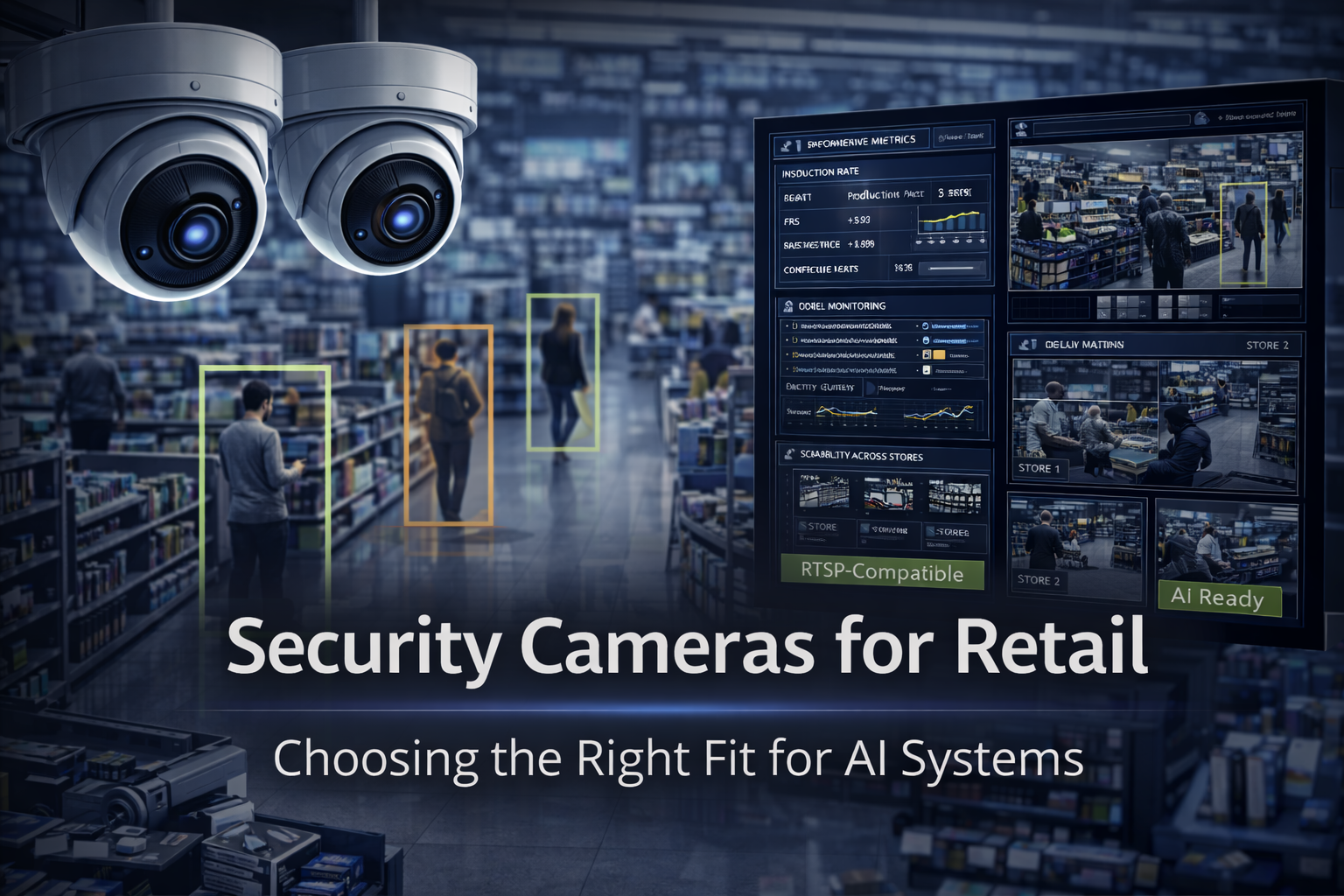
Choosing the Right Fit When AI Is Part of the Stack
Retail security is a new era. The decision, once considered simple to make, install cameras, record footage, and monitor when necessary, has turned into a strategic technology choice. With the rise of artificial intelligence and the widespread application of AI in the retail environment, the selection of security cameras for retail is no longer about the quality of images or the range. It is concerned with data readiness, systems compatibility and scalability over time.
With the AI on the stack, the cameras do not solely record the data; they become the data sources. The correct decision has the power to open operational intelligence, whereas the incorrect one can restrict the performance of your AI devices. This blog discusses the way retailers need to tackle the choice of security cameras in retail, where the main objectives are AI-driven analytics, automation, and insight.
Why Camera Choice Matters More in an AI-Driven Retail Environment
AI transforms the purpose of cameras. AI-driven platforms actively analyse live and recorded video to extract patterns, detect events, and flag anomalies. It implies that the quality, format, and availability of video data become a crucial part of the mission.
The difficulty that retailers who begin using AI at retail loss prevention, retail operations, or retail customer insights quickly come to realise is that not all cameras are equal. Others impose restrictions on resolution, frame rates, or access to data-forming blind spots to analytics. Others connect smoothly to modern platforms, allowing teams to gain deeper insights.
By selecting AI-aware security cameras for retail, you are certain that your infrastructure will be able to meet your current requirements as well as the progressive requirements of tomorrow.
Understanding the Role of Security Cameras for Retail in an AI Stack
AI stack generally consists of cameras, network infrastructure, a video management system (VMS), an analytics engine, and dashboards. On the verge of this ecosystem are cameras. If they do not deliver high-quality, consistent streams, downstream systems suffer.
The micro-evaluation of security cameras fo retail must consider more than the security use-cases. Inquire about the role of the camera in larger goals like operational efficiency, experience, and data-driven decision-making.
Resolution, Frame Rate, and Field of View: The Foundation for AI
AI models are dependent on visual clarity. Although simple security can operate using a low level of resolution, AI programs usually demand finer images to identify movement, dwell time, or accurately analyse interaction.
Stable frame rates and high-definition video enhance the performance of AI-ready security cameras and allow the cameras to act more accurately during the detection of objects and analysis of behaviour. Likewise, the field of view is also important: wide-angle lenses could minimise blind spots, but can distort unless they are adequately trained to work with AI models.
It depends on balancing out: finding cameras that will provide data to us that can be used and does not strain our network or our storage.
The Importance of AI-Ready Security Cameras
Not all cameras sold today are AIs compatible. The AI-ready security cameras are aimed at the processing power, the flexibility of the firmware and access to the data. They have the capability to back up enhanced analytics at the edge or cloud-based architecture.
The availability of AI-ready security cameras makes integration with computer vision easier and eliminates the necessity of expensive hardware upgrades in the future. These cameras have the ability to develop with advances in AI models, and safeguard your investment in the long run.
Connectivity and RTSP IP Camera Compatibility
Protocol compatibility is one of the most neglected yet important factors. The AI platforms usually support the use of common streaming protocols to ingest video. Comprehensible with RTSP IP cameras is necessary to guarantee that your cameras can communicate dependably with AI analytics products.
Cameras with RTSP IP camera compatibility are flexible. Instead of confining retailers to proprietary ecosystems, they are able to interoperate with several VMS and AI systems. This transparency is needed particularly because AI vendors and capabilities keep evolving fast.
In considering security cameras in retail, verify that the cameras can be open standard and that they give predictable and documented access to video streams.
Edge vs. Cloud: Where AI Processing Happens
Security cameras for retail are now being shipped with in-camera AI processing, and others fully utilize cloud or server-based analytics. Each approach has trade-offs.
Edge processing minimizes latency and bandwidth consumption, allowing quicker alerts and real-time reactions. Cloud processing, however, has more complex models and can be easily updated. The optimal option varies with the size of stores, capacity of the network and applications.
Cameras have to provide high-quality streams consistently no matter where the processing is taking place. It is the other reason why we should choose AI-ready security cameras, which can operate in support of both architectures.
Scalability Across Locations
Retailers do not have cameras in a single store. One of the requirements is scalability. A camera that performs well in one store might not be efficient when copied to dozens or hundreds of stores.
The selection of standardised security cameras for retail simplifies the deployment and maintenance of security cameras and the consistency of AI models. Standard hardware will enable analytics to be consistent between locations so that analytics becomes more believable at scale.
Scalable systems are also RTSP IP camera compatibility so that centralised AI platforms can ingest data across multiple stores without specific integrations.
Data Quality and Consistency for Analytics
AI is dependent on regular information. Differences in accuracy can occur through lighting, camera angle or video quality. Although certain variability is inevitable, the selection of the appropriate hardware reduces such problems.
Local retailers must focus on high-performance cameras with good low-light capability, dynamic range and consistent uptime. These features make AI applications used in conjunction with security cameras for retail more efficient, whether related to loss prevention or storage analytics.
Interoperability between devices also makes training models easier, as well as minimising false positives.
Cybersecurity and Network Considerations
Since cameras are becoming smarter and more connected, they are also growing to be your IT attack surface. This is necessary to have secure firmware, encrypted streams, and updates.
The significance of this fact is multiplied by AI deployments due to the fact that compromised cameras do not merely endanger footage but can also impair analytics and decision-making systems. When choosing security cameras for retail, consult IT teams so that security standards are met.
Strong authentication and network segmentation as part of open protocols such as RTSP IP camera compatibility must be implemented to still ensure security without compromising flexibility.
Future-Proofing Your Investment
Artificial intelligence is developing quickly. Retailers are not supposed to be tied to cameras that make them dependent on ageing hardware or a closed ecosystem. Future-proofing refers to the selection of hardware with the ability to evolve and scale to new AI platforms via firmware updates, modular design, or compatibility.
In particular, AI-ready security cameras are designed with this increase in sight. They promote continued innovation, which does not involve constant replacement, which makes them a smarter long-term decision.
This strategy will make your security cameras for retail an asset, not a technical liability.
Aligning Camera Choice with Business Goals
Finally, your choice should be the correct camera according to your desired AI results. When operational efficiency is your priority, you should concentrate on extensive coverage and dependability. When clarity, consistency, and analytics-friendly formats are important, look to customer insight.
The most effective retailers consider security cameras for retail as strategic infrastructures, rather than security devices. This mentality can help AI create quantifiable business value.
Final Thoughts
Attempting to select cameras in an AI-enabled retail world takes a bigger point of view. It is not merely a matter of observation but a matter of learning, anticipating and evolving. The appropriate decisions have scaled AI systems to deliver insights at scale with AI-ready security cameras and RTSP IP camera compatibility.
The cameras you use today will determine how you can shop tomorrow because AI is becoming a part of retailing. When investing heavily, consider development, and use video as the treasure trove it has become.
Is your retail camera ready to be AI-enabled?
Watch VisionBot enable retailers to build high-powered AI-driven insights with their existing camera infrastructure.